How to Build a Multi-Platform Influencer Analytics Dashboard (Instagram, TikTok, YouTube)

From Social Media APIs to Real-Time Influencer Intelligence
Modern influencer marketing platforms are built on one core foundation: social media APIs.
If you are not familiar with how these APIs work, you should first read our foundational guide:
What Is an API? Understanding Social Media APIs in 2026
This article focuses on the implementation layer—how to actually turn fragmented API data from Instagram, TikTok, and YouTube into a unified analytics dashboard used for influencer vetting.
Why Influencer Analytics Is a Hard Engineering Problem
At first glance, building an influencer dashboard looks simple:
Fetch followers
Pull engagement data
Display metrics
But in real systems, things break quickly once you scale beyond a few hundred creators.
In a prototype we worked on for a SaaS analytics tool, nearly half of engineering time was spent maintaining API integrations instead of building product features.
The main issue is not data access—it is data inconsistency across platforms.
Core Data You Actually Need from Social Media APIs
To evaluate influencer performance properly, you need more than follower counts.
Key fields:
followers_count
media_count
engagement metrics (likes, comments)
impressions (if available)
One challenge is that Instagram data availability depends heavily on account type and permissions. Business accounts provide significantly more insights than personal accounts.
TikTok API
TikTok is the most volatile data source.
Important metrics:
follower_count
view_count
share_count
per-video performance
Unlike other platforms, TikTok engagement can spike dramatically within hours. This makes caching strategy critical.
YouTube Data API v3
YouTube provides stable but deeply nested data:
subscriberCount (string inside statistics object)
videoCount
video-level analytics
A common mistake is assuming YouTube metrics are real-time—they often lag behind actual user behavior.
The Real Problems Developers Face When Integrating APIs
1. Schema Fragmentation Across Platforms
Each platform defines metrics differently:
Instagram: followers_count (integer)
YouTube: subscriberCount (string)
TikTok: nested analytics objects
This forces teams to build a normalization layer that becomes harder to maintain over time.
2. Rate Limits and Access Restrictions
In production environments, API limits are one of the first bottlenecks:
Meta API requires app review and permission approval
TikTok access varies by region and account type
YouTube enforces strict quota limits per project
At scale, batch processing influencer data often triggers throttling instantly.
3. Why Caching Becomes a Risk
Caching improves performance but reduces accuracy.
In influencer analytics, stale data leads to wrong decisions.
For example:
A TikTok video may go from 0 → 1M views in a few hours
Cached data may miss the entire growth phase
A better approach is using short TTL caching (5–15 minutes) combined with selective real-time fetching.
A Scalable Architecture for Social Media Data
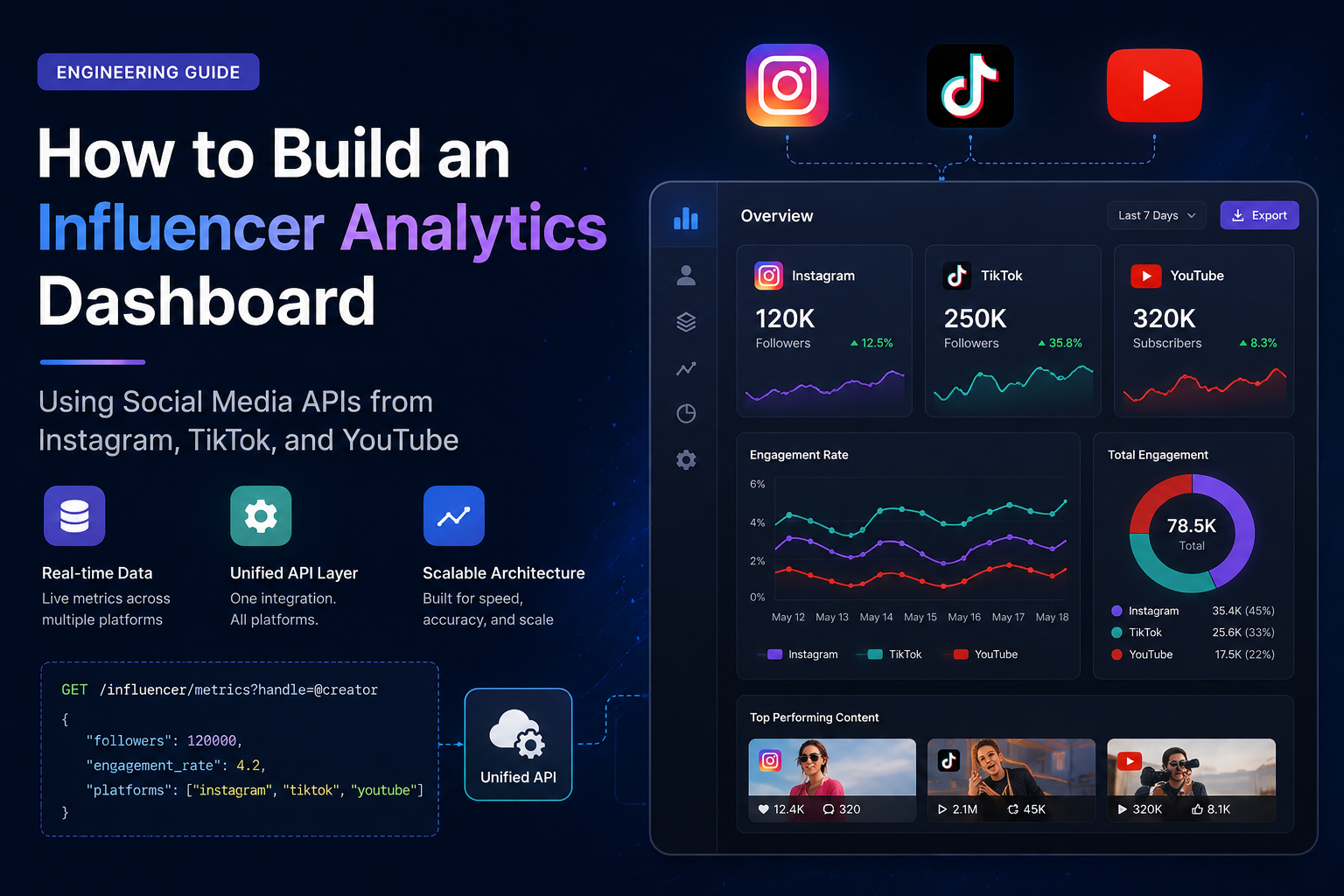
Instead of integrating each platform separately, modern systems use a unified data layer.
Unified API Layer Approach
A unified API abstracts:
Authentication complexity
Platform-specific schemas
Rate limit handling
Example request:
GET /influencer/metrics?handle=@creatorExample normalized response:
{
  "followers": 120000,
  "engagement_rate": 4.2,
  "platforms": ["instagram", "tiktok", "youtube"]
}
Internal Data Flow Architecture
A typical production system includes:
API Gateway (request routing)
Normalization service (schema mapping)
Queue system (Kafka / SQS)
Redis cache (short TTL)
Analytics layer (aggregation)
Real-Time vs Cached Data Strategy
A practical hybrid approach:
Real-time fetch for trending influencers
Cached data for stable accounts
Background refresh for historical metrics
This balances accuracy and performance.
Connecting Back to API Fundamentals
This architecture is not possible without understanding how APIs behave under real-world constraints like rate limits, authentication flows, and schema inconsistency.
If you want a deeper breakdown of these fundamentals, revisit:
What Is an API? Understanding Social Media APIs in 2026
That article explains the underlying mechanics that make this system possible.
Final Thoughts
Building an influencer analytics dashboard is not just a frontend or backend problem—it is a data infrastructure problem.
The teams that succeed are not those who integrate APIs fastest, but those who design systems that can survive:
changing schemas
unstable rate limits
inconsistent real-time data
If you design your system around these constraints from day one, scaling becomes significantly easier.