One Unified API for TikTok, Instagram, YouTube & 20+ Platforms

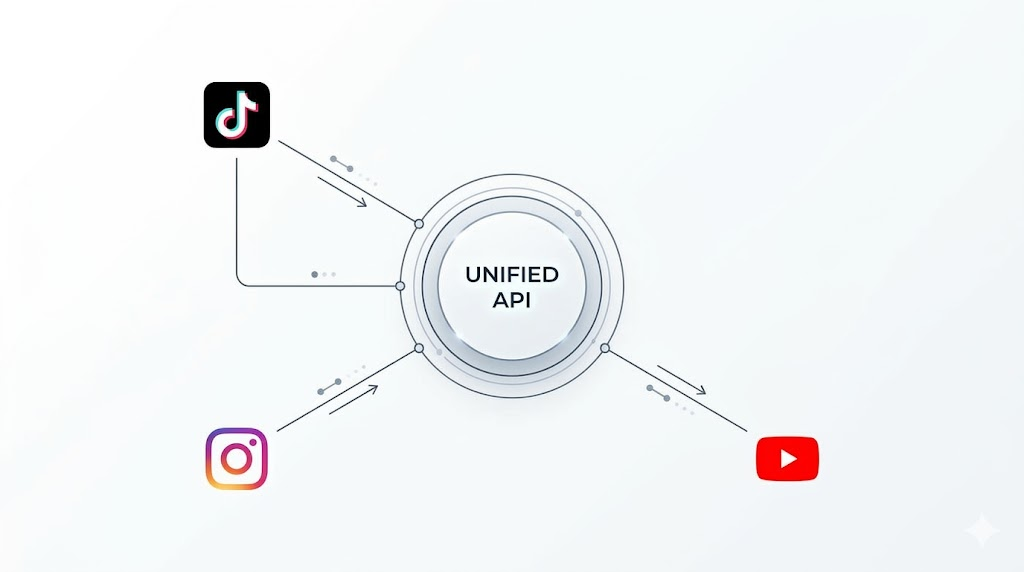
If you have ever attempted to collect analytics from TikTok, Instagram, and YouTube at the same time, you already know how quickly social media integrations can become unstable and difficult to maintain.
While building our internal infrastructure at KeyAPI.ai., our engineering team initially assumed multi-platform integrations would simply involve reading API documentation and sending a few requests. In reality, maintaining stable access across rapidly changing platforms became more time-consuming than building the actual product itself.
At first, we tried using official APIs wherever possible. That approach worked temporarily, but scaling quickly exposed several problems. Instagram’s Graph API required complex business verification flows just to access public metrics. TikTok frequently updated request signatures and anti-bot protections, while YouTube’s quota system limited how much data we could realistically retrieve at scale.
Over time, we realized the problem was not simply “getting data.” The real challenge was maintaining reliable access across completely different systems with inconsistent authentication, response structures, and rate limits.
Instead of continuing to patch individual integrations, we rebuilt our architecture around a centralized social media data pipeline capable of standardizing responses across 20+ platforms.
Why Multi-Platform Integrations Become Expensive
Most developers underestimate how much maintenance fragmented APIs require after launch.
Internally, we tracked our development workload for several months and discovered that a significant percentage of engineering time was being spent on issues unrelated to product innovation:
Refreshing expired authentication sessions
Rebuilding broken TikTok signatures
Updating rotating cookies and headers
Handling proxy bans and WAF restrictions
Normalizing inconsistent JSON structures
Managing platform-specific rate limits
In some months, maintenance alone consumed more than 100 development hours.
The bigger problem was reliability. Sequentially querying multiple platforms introduced substantial latency into our application, especially when handling real-time video analytics requests. Some requests failed entirely because one provider changed a parameter or introduced a new verification step without warning.
This fragmentation becomes especially painful when building influencer marketing tools, creator dashboards, AI agents, or social intelligence products that rely on real-time data consistency.
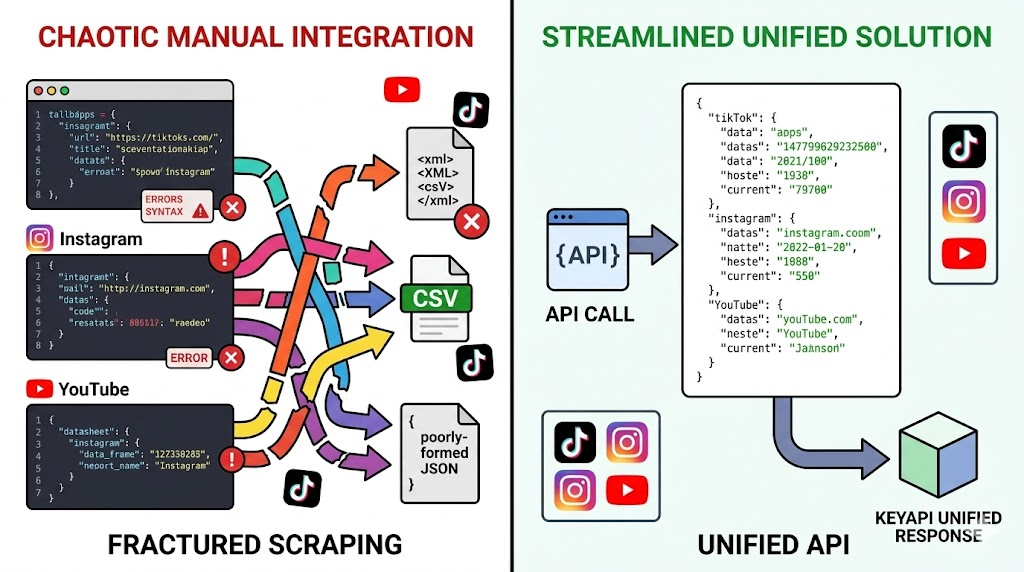
The Shift Toward a Unified API Architecture
After repeatedly rebuilding integrations from scratch, we moved toward a unified API approach.
Rather than treating TikTok, Instagram, and YouTube as isolated systems, we standardized their responses into a single schema. That meant developers could work with one predictable structure instead of maintaining completely separate integrations for every platform.
The result was a much cleaner architecture:
One authentication layer
One response format
One request structure
One scalable infrastructure layer
Instead of maintaining separate modules for every social platform, our applications could process data through a single pipeline. More importantly, this approach reduced long-term maintenance overhead dramatically.
Accessing YouTube Shorts Analytics Efficiently
YouTube’s official API is reliable in some areas, but quota restrictions become a serious limitation once applications begin scaling.
For products that continuously monitor Shorts performance, engagement metrics, or creator growth, quota exhaustion can quickly become a bottleneck.
To solve this issue, we documented a streamlined workflow for retrieving Shorts analytics more efficiently in our guide to KeyAPI Free YouTube Shorts and Reels Data. This includes handling video metrics, comments, engagement tracking, and creator analytics in a more scalable way.
Tracking Instagram Reels Without Authentication Complexity
Instagram remains one of the most restrictive platforms when it comes to public engagement tracking.
Many developers discover too late that competitor analytics, Reels metrics, and public performance data often require complicated authentication flows tied to Facebook Business verification.
Even when integrations initially work, token expiration and permission reviews can disrupt production systems unexpectedly.
To address these challenges, we published a detailed walkthrough covering Instagram Reels API access and engagement tracking, including practical methods for handling public data extraction more reliably.
Managing TikTok’s Anti-Bot Systems
TikTok has become one of the most technically difficult platforms to integrate with consistently.
Modern anti-bot protections such as dynamic signatures, fingerprint validation, and rapidly changing request parameters make long-term scraping infrastructure extremely difficult to maintain internally.
Many teams underestimate how much ongoing engineering work TikTok integrations require until production traffic begins scaling.
To help developers understand these challenges more clearly, we created a complete technical guide on TikTok Reels data extraction and trend analysis, including how modern anti-bot systems impact data reliability.
Beyond the Big Three: Scaling to 20+ Platforms
While YouTube, Instagram, and TikTok represent the most complex integrations due to their massive scale and strict anti-bot measures, a truly unified architecture cannot stop there.
Comprehensive social listening, influencer discovery, and AI training require a much wider net. This is why the KeyAPI infrastructure extends its standardized JSON schema to over 20 additional platforms.
Whether you need to pull discussion threads from Reddit, track engagement velocity on X (Twitter), monitor Pinterest boards, or analyze Snapchat and LinkedIn profiles, the data flows through the exact same unified pipeline. You do not need to write a new authentication module for Reddit or a new parser for Pinterest; you simply adjust the platform parameter in your API request and receive the same clean, predictable data structure.
Why Real-Time Data Accuracy Matters
One lesson we learned early was that cached data quickly becomes unreliable for analytics products.
For influencer auditing, campaign monitoring, or trend detection, even small delays in engagement updates can create inaccurate reporting.
Because of this, our infrastructure was designed around real-time querying instead of serving outdated cached responses whenever possible.
When developers request metrics for a trending TikTok video, YouTube Short, or Instagram Reel, the system retrieves fresh platform data directly from live environments instead of relying entirely on stale snapshots.
For AI-driven analytics systems and automation workflows, maintaining accurate real-time data becomes increasingly important as products scale.
Stop Maintaining APIs and Start Building Products
The biggest mistake most teams make is assuming social platform integrations are “finished” once the API connection works. In reality, long-term maintenance becomes the real cost.
Every hour spent fixing broken tokens, bypassing anti-bot systems, or rebuilding unstable integrations is time that could have been invested into improving the actual product experience.
A unified social media API architecture dramatically reduces this operational burden by standardizing how applications access social data across platforms.
Instead of maintaining separate infrastructure for TikTok, Instagram, YouTube, Reddit, and other platforms, developers can focus on building scalable products on top of a consistent data layer.
If your team is building creator tools, AI agents, automation systems, or social analytics products, consolidating fragmented APIs into a unified infrastructure layer will save significant engineering time over the long term.
You can explore the full platform capabilities and test endpoints directly through KeyAPI.ai.