What Is an API? Understanding Social Media APIs in 2026

If you search “API” on Google today, you’ll immediately see definitions from companies like Amazon Web Services, Cloudflare, and Wikipedia.
Most of them describe APIs like this:
“An Application Programming Interface that allows software systems to communicate using protocols and definitions.”
Technically, that’s correct.
But if you’re running an e-commerce brand, building a SaaS product, managing influencer campaigns, or trying to pull TikTok analytics into a dashboard, that explanation is almost useless.
You are not trying to pass a computer science exam.
You are trying to answer questions like:
How do I get TikTok or Instagram data automatically?
Why are social media APIs so difficult to maintain?
How do platforms like YouTube, TikTok, and Instagram connect to analytics tools?
What exactly does an API do for a business?
Is there a simpler way to collect social media data without building everything from scratch?
This guide explains APIs from a real business perspective — not from a textbook.
More importantly, it explains why unified social media APIs are becoming one of the most important infrastructure layers for modern SaaS products, AI tools, influencer platforms, and e-commerce analytics systems.
What Is an API? (The Simplest Explanation)
Forget programming for a moment.
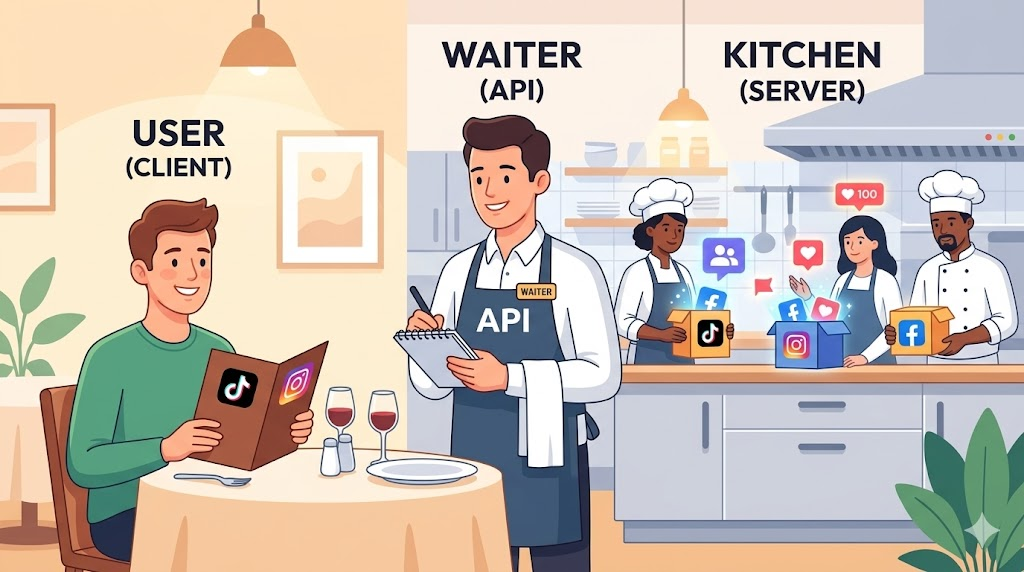
Imagine you’re sitting inside a restaurant.
The Restaurant Analogy
You = The Customer
You want something specific.
For example:
TikTok creator analytics
Instagram Reels engagement
YouTube Shorts statistics
Trending hashtags
Influencer audience data
The Kitchen = The Platform Database
TikTok, Instagram, and YouTube all have massive databases filled with content and analytics.
But you cannot walk directly into their systems and take the data yourself.
That would be chaotic and insecure.
The Waiter = The API
The waiter takes your request to the kitchen.
Then the waiter returns with exactly what you ordered.
That waiter is the API.
An API is simply a secure messenger between applications.
It allows one software system to request data from another system in a structured and controlled way.
Why APIs Matter More Than Ever in 2026
Modern internet businesses run on APIs.
Without APIs, most platforms you use every day would stop functioning.
Examples of APIs You Already Use Daily
When you:
connect Shopify to TikTok Ads
log into apps using Google
schedule Instagram posts
track influencer analytics
monitor YouTube video performance
analyze TikTok trends
sync CRM customer data
…you are using APIs behind the scenes.
APIs are the invisible infrastructure powering modern software.
The Problem: Social Media APIs Are Extremely Fragmented
This is where most businesses run into problems.
A few months ago, our team started building a multi-platform social media analytics system.
At first, we assumed the process would be simple:
“Just connect to TikTok, Instagram, and YouTube APIs.”
Reality was very different.
We quickly discovered that every platform behaves differently.
Why Traditional APIs Become a Nightmare
1. Every Platform Uses Different Rules
TikTok APIs work differently from Instagram APIs.
Instagram uses Meta Graph architecture.
YouTube has quota systems.
TikTok uses anti-bot signatures and dynamic request validation.
Nothing is standardized.
Your developers end up maintaining multiple completely separate infrastructures.
2. Official APIs Are Full of Restrictions
Most social platforms heavily limit access.
For example:
Instagram requires business verification
TikTok limits many public endpoints
YouTube enforces strict API quotas
Some endpoints require compliance reviews
For startups and smaller teams, this creates massive delays.
Instead of building products, developers spend weeks dealing with approvals and documentation.
3. APIs Constantly Break
This is the hidden cost most businesses underestimate.
Social platforms update systems constantly.
An endpoint working today may stop functioning tomorrow.
That means:
broken dashboards
missing analytics
failed automations
emergency engineering fixes
rising infrastructure costs
At scale, API maintenance becomes a full-time operational burden.
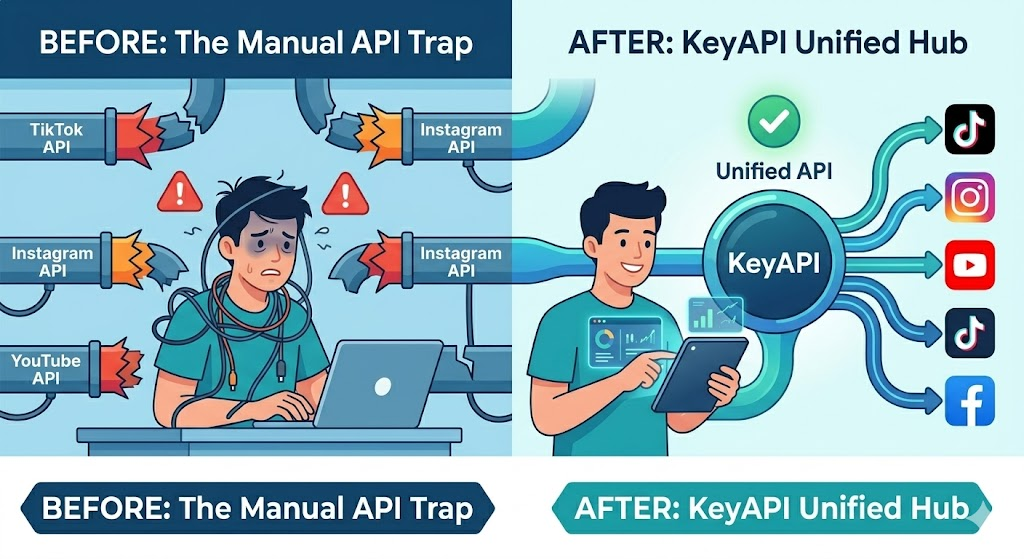
The Bigger Problem: Developers Spend More Time Maintaining APIs Than Building Products
This is the turning point many SaaS teams eventually reach.
You realize:
Your competitive advantage is not maintaining TikTok signatures or fixing Instagram authentication tokens.
Your advantage is your actual product.
But fragmented APIs consume engineering resources endlessly.
That’s exactly why unified API systems started becoming popular.
What Is a Unified API?
A unified API combines multiple platforms into one standardized structure.
Instead of building:
one TikTok integration
one Instagram integration
one YouTube integration
one Facebook integration
one Reddit integration
…you connect once.
Then everything becomes standardized.
How KeyAPI Simplifies Social Media Data Access
KeyAPI.ai was built around this exact problem.
Instead of forcing developers to manage dozens of unstable integrations, KeyAPI provides one unified social media API layer for TikTok, Instagram, YouTube, and 20+ additional platforms.
The idea is simple:
Your Application
↓
KeyAPI
↓
TikTok + Instagram + YouTube + More
Your application only needs one integration.
KeyAPI handles the complex backend infrastructure.
That includes:
authentication logic
signature generation
request standardization
anti-bot handling
platform compatibility
response formatting
Instead of managing multiple unstable systems, developers work with one consistent API structure.
Why Unified APIs Are Becoming Essential for AI & SaaS Products
In 2026, APIs are no longer just developer tools.
They are becoming core business infrastructure.
Especially for:
AI applications
influencer marketing platforms
social listening tools
e-commerce analytics
trend monitoring systems
automated content engines
creator economy platforms
These businesses rely on clean, structured, real-time data.
Without standardized APIs, scaling becomes extremely difficult.
Real-World Example: Cross-Platform Video Analytics
Let’s say you want to build a dashboard comparing:
TikTok videos
Instagram Reels
YouTube Shorts
Sounds simple.
But normally you would need:
separate authentication systems
separate JSON structures
separate rate-limit handling
separate maintenance workflows
That creates huge engineering overhead.
A unified API removes that complexity completely.
Accessing YouTube Shorts Data
YouTube’s official APIs often become difficult at scale because of quota restrictions.
For teams needing Shorts analytics, engagement metrics, and creator performance tracking, standardized endpoints dramatically simplify development.
For a deeper breakdown, this guide explains the process in detail:f
How to Access YouTube Shorts & Reels Data
Tracking Instagram Reels Analytics
Instagram data access is notoriously restrictive.
Public competitor analytics are difficult to retrieve reliably through traditional methods.
Unified API structures simplify real-time Reels tracking significantly.
If you work with Instagram analytics or creator intelligence, this guide is worth reading:
Instagram Reels Data API Guide
Analyzing TikTok Video Trends
TikTok remains one of the hardest platforms for developers because of aggressive anti-bot systems and dynamic request signatures.
Maintaining custom TikTok scrapers is extremely resource-intensive.
This guide explains how unified API systems simplify TikTok data extraction:
TikTok Reels API & Trend Tracking Guide
The Hidden Business Cost Most Companies Ignore
The real issue is not API access itself.
It’s maintenance.
Most companies underestimate:
engineering hours
debugging time
infrastructure instability
proxy costs
failed data pipelines
broken integrations
A fragmented architecture quietly drains operational budgets.
Unified APIs reduce that burden dramatically.
APIs Are No Longer Optional Infrastructure
Ten years ago, APIs were mostly developer tools.
Today, APIs are the foundation of modern digital businesses.
If your product relies on:
social media analytics
creator tracking
AI workflows
automation systems
cross-platform monitoring
…then your infrastructure strategy matters.
The companies scaling fastest are not necessarily building more APIs.
They are simplifying them.
Final Thoughts
Most articles explaining APIs make the topic unnecessarily complicated.
But the reality is simple:
An API is just a bridge that allows systems to exchange data securely and efficiently.
The real challenge begins when you try managing dozens of fragmented APIs simultaneously.
That’s why unified API platforms are becoming increasingly important for SaaS companies, marketers, AI startups, and analytics platforms.
Instead of wasting months maintaining unstable integrations, businesses can focus on what actually matters:
building products
growing users
improving analytics
scaling revenue
If you want to explore how unified social media APIs work in practice, you can visit KeyAPI.ai and explore the platform directly.