KeyAPI vs Direct Platform APIs: Which One Makes Sense for Your Product?


The question is usually not whether an API exists. The question is whether your team should keep building platform integrations one by one or move to a unified layer before the maintenance work starts eating the roadmap. That is where KeyAPI becomes relevant. If you have not yet read the core overview, start with [What Is KeyAPI? A Unified Social Media API for Developers, Data Teams, and AI Workflows]. This article focuses on the decision itself: when direct platform APIs are still fine, and when KeyAPI becomes the smarter product choice.
What usually pushes people toward KeyAPI
Nobody wakes up, stretches, and says, “Today I would love to normalize five social data models before lunch.” People move toward KeyAPI because something else has already become annoying.
Sometimes it is a dashboard project. Sometimes it is a monitoring workflow. Sometimes it is an internal data tool that looked simple until the third platform joined the party and brought its own naming system, limits, and edge cases. The trigger changes, but the pattern is familiar: one integration becomes two, two become four, and suddenly the infrastructure part has become more demanding than the actual business use case.
That is where KeyAPI starts to make sense. It gives teams one cleaner access layer for multi-platform social data, so they can stop rebuilding the same kind of plumbing over and over.
What KeyAPI makes easier
Cross-platform work stops feeling like five separate projects
Working platform by platform is manageable for a while. Then somebody asks for a unified report, a competitor view, a content monitoring workflow, or an AI agent that needs fresh inputs from more than one source. At that point, the “we’ll just connect them one by one” plan begins to age badly.
KeyAPI is useful because it reduces fragmentation. Instead of treating each platform like a separate engineering island, you get a more unified way to work with the data. That makes downstream systems easier to build and much easier to maintain.
If your immediate goal is reporting, this pairs naturally with How to Build a Multi-Platform Social Media Dashboard with One API Layer.
Dashboards become less fragile
A dashboard is not hard because charts are mysterious. It is hard because bad inputs make everything wobble.
When the data layer underneath your dashboard is stitched together from different platform rules, refresh timings, and field structures, the reporting layer inherits all that mess. One broken connector or changed schema can turn a calm week into a small internal crisis.
KeyAPI gives you a more stable base for dashboards, reporting systems, and recurring analytics workflows. That does not mean no work is required. It means the work starts from a cleaner foundation.
For a deeper dashboard angle, your article How to Build a Multi-Platform Social Media Dashboard with One API Layer is a strong internal link target here.
Monitoring and alerts become more practical
This is where teams often discover they do not actually need “more APIs.” They need fewer moving parts.
If you are trying to track mentions, content shifts, creator activity, or competitor signals across multiple platforms, platform-by-platform logic becomes a maintenance habit you regret later. KeyAPI helps simplify that by giving you one more consistent starting point for monitoring workflows.
That is also why it fits well with the broader idea behind Unified Social Media API: How to Access TikTok, YouTube, Threads, and More in One Workflow.
AI workflows get cleaner inputs
AI tools love clean inputs. Human teams do too, but AI tools complain less dramatically.
If you are feeding social data into an agent, enrichment workflow, classifier, internal search layer, or automated content system, you do not want half the work to be “translate field A into field B, then remember platform C does it differently.” You want consistent, usable inputs that your workflow can actually depend on.
KeyAPI helps by making that input layer less chaotic.
When direct platform APIs are still fine
To be fair, KeyAPI is not automatically the right answer for every situation.
One platform, one narrow use case
If you only need one platform and the workflow is tightly scoped, going direct can still be perfectly reasonable. There is no prize for overengineering something simple.
Experimental projects
If you are validating a tiny proof of concept and you only need a small slice of one platform, direct access may be faster at the beginning.
Internal teams with highly custom platform-specific needs
Some teams genuinely need the quirks of a direct platform implementation because their product depends on it. That is a real case, and it is not wrong.
The trouble starts when a workflow that looked narrow quietly turns into a cross-platform system. That is when teams realize they did not build one neat integration. They built a collection of separate responsibilities that all need babysitting.
When KeyAPI becomes the smarter choice
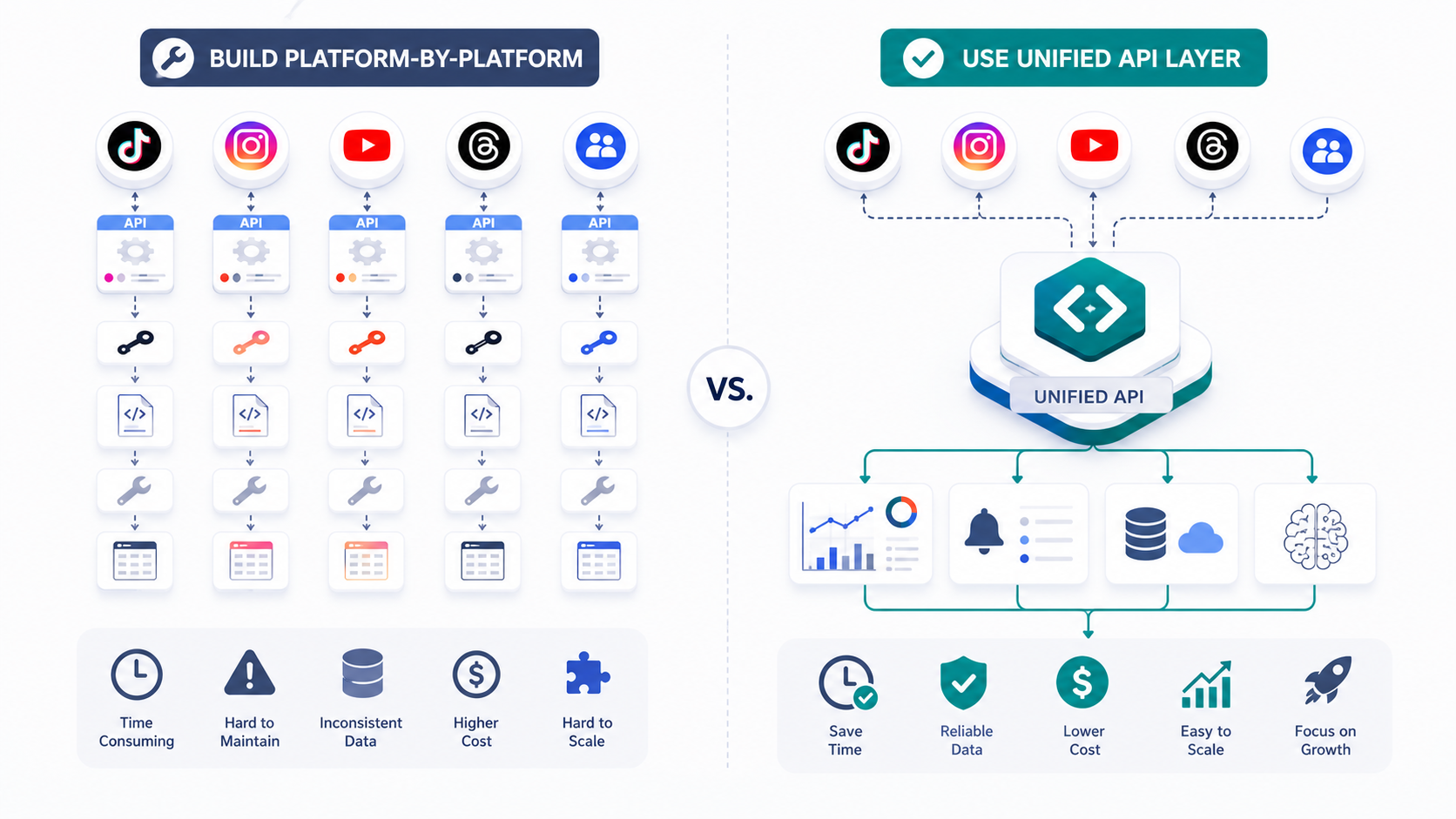
If the comparison already points you toward a unified layer, the next practical question is what you can actually ship with it. That is where [What Can You Build With KeyAPI? 4 Practical Use Cases for Social Data Teams] becomes useful, because it moves the discussion from architecture choices to concrete outputs.
When you need more than one platform
This is the obvious one, but it matters. Once your product, dashboard, or workflow depends on multiple social platforms, the cost of doing everything separately grows fast.
When engineering time is more valuable than DIY pride
. It lasts right up until maintenance begins billing interest.
If the real goal is to ship a dashboard, a monitoring product, an internal research tool, or an AI workflow, KeyAPI helps teams spend more time on the part users care about and less on repetitive integration debt.
When reporting needs to be repeatable
A one-off export can survive on manual work. A recurring reporting workflow cannot. If leadership, clients, internal teams, or customers need dependable views across channels, the data layer has to stop improvising.
That is where KeyAPI becomes more than a convenience. It becomes infrastructure.
When your workflow needs to scale without becoming weird
Small systems tolerate messy logic for longer than they should. Growing systems do not. Once more users, more dashboards, more data flows, or more automation steps get involved, fragile setup choices become visible very quickly.
KeyAPI helps teams grow without turning every new request into another patch.
What someone should ask before choosing KeyAPI
Are we building around one platform or many?
If the answer is many, KeyAPI immediately becomes more relevant.
Is our real problem access, or maintenance?
A lot of teams think their issue is “we need an API.” What they really mean is “we need a simpler system that we can trust three months from now.”
Are we building a product, a report, a monitor, or an AI workflow?
The clearer the use case, the easier it is to judge whether unified access will save time.
Are we spending too much effort on the data layer itself?
This is usually the quiet signal that tells you the architecture has started consuming the roadmap.
What this means for someone searching “KeyAPI”
If someone searches KeyAPI, they are often already past the generic discovery stage. They are trying to understand whether KeyAPI is just another connector, another layer they do not need, or an actual shortcut to a cleaner system.
The answer is simple: KeyAPI is most valuable when your work depends on cross-platform social data and you want a more practical way to use it for dashboards, analytics, monitoring, automation, or AI workflows.
If your world is one platform and one narrow task, direct APIs may still be enough. If your workflow touches several platforms and needs to last, KeyAPI is usually the more scalable decision.
Final thought
Platform-by-platform integration feels efficient right up until it becomes your full-time personality.
That is why people move to KeyAPI.
Not because it sounds elegant in a slide deck. Not because “unified API layer” is a trendy phrase. Because at some point, teams want to stop fixing the same class of problem over and over and get back to building the thing that actually matters.
If that sounds familiar, start with KeyAPI.ai. If your next question is about reporting, go next to Social Media Analytics API: How to Build Cross-Platform Reporting That Actually Works. If your focus is access and orchestration, Unified Social Media API: How to Access TikTok, YouTube, Threads, and More in One Workflow is the best internal next step.
FAQ
Is KeyAPI only useful for dashboards?
No. Dashboards are one strong use case, but KeyAPI also fits monitoring, alerts, competitive research, internal tools, reporting workflows, and AI systems that depend on social platform data.
Is KeyAPI better than direct platform APIs?
Not in every case. If your workflow is extremely narrow and limited to one platform, direct APIs may still be fine. KeyAPI becomes more valuable when the workflow spans multiple platforms or needs to stay maintainable over time.
Why do developers choose KeyAPI?
Usually because they want to reduce integration debt, simplify cross-platform work, and stop spending too much product time on platform-specific maintenance.
Can KeyAPI support AI workflows?
Yes. It is especially useful when AI agents or automation systems need cleaner, more consistent social data inputs from multiple platforms.
What should I read before this article?
If you want the entity-definition page first, pair this piece with your “What Is KeyAPI?” article. If you want the product-facing angle, the homepage at KeyAPI.ai is the natural starting point.