Influencer Engagement Rate API: Follower Count vs Real Creator Performance


Most influencer mistakes start with one number.
Follower count.
It is easy to understand, easy to compare, and easy to put in a spreadsheet. That is why teams keep using it.
But after you run a few campaigns, follower count starts to feel less reliable. A creator with 600,000 followers can produce a weak sponsored post. A smaller creator with 40,000 followers can bring better comments, better clicks, and a more serious audience.
That is usually the moment teams start searching for an influencer engagement rate API.
They are not looking for another vanity metric. They are trying to answer a practical question before spending money:
Is this creator’s audience still paying attention?
If you are new to how social media APIs work, read this first:
What Is an API? Understanding Social Media APIs in 2026
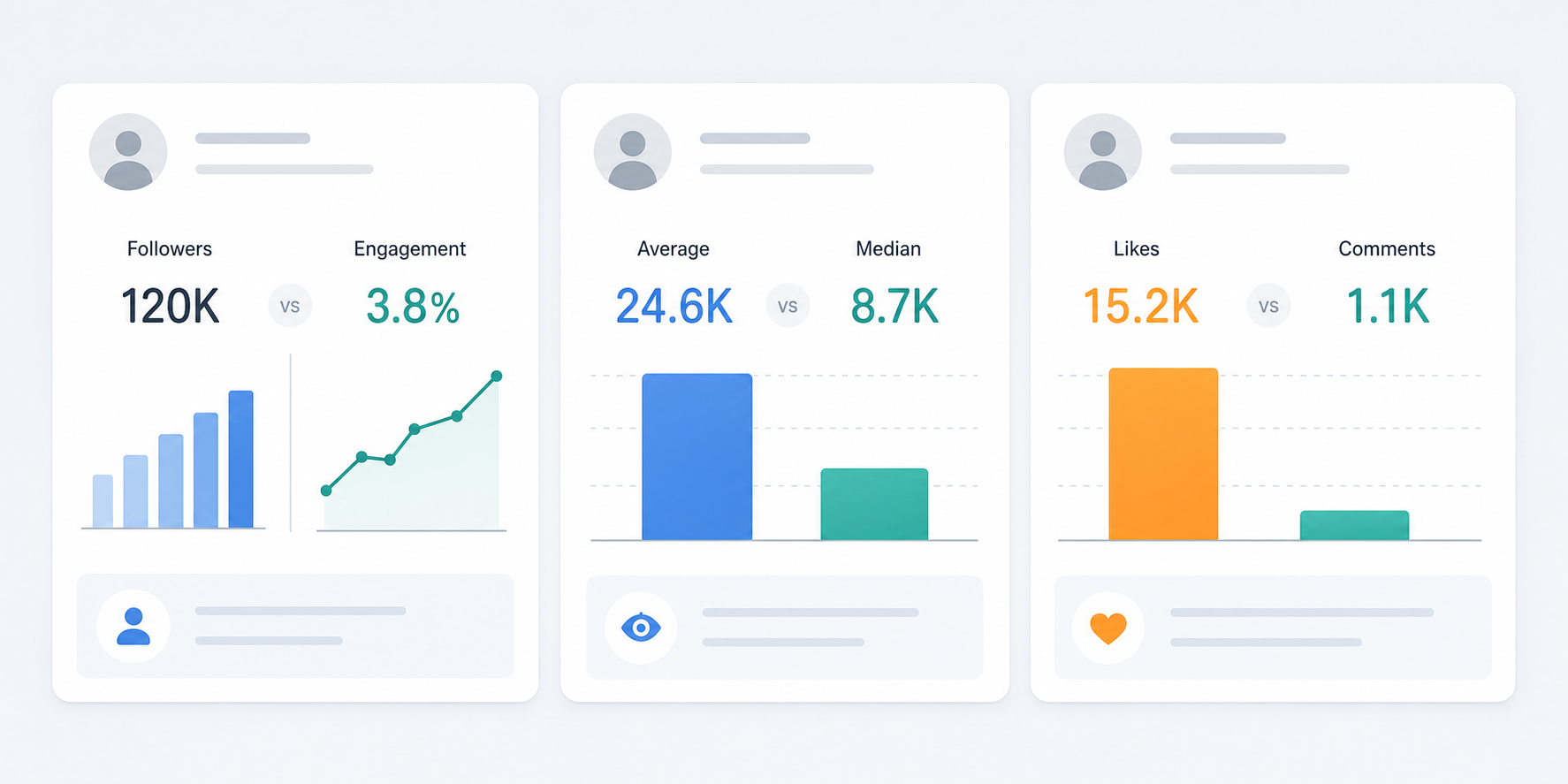
Follower Count vs Engagement Rate: Which One Should You Trust?
Follower count tells you the size of a creator’s possible audience.
Engagement rate tells you whether people still respond.
That difference matters.
A creator may have a large audience because they were popular two years ago. Their profile still looks impressive, but their recent videos may be flat. Another creator may have a smaller audience, but every post gets real comments from people asking questions, comparing products, or tagging friends.
For campaign decisions, the second creator may be more valuable.
When Follower Count Still Matters
Follower count is not useless.
It helps you understand creator size, pricing range, and potential reach. If two creators have similar engagement quality, the larger creator may still be the better choice.
But follower count should be context, not the final decision.
When Engagement Rate Matters More
Engagement rate becomes more useful when you need to compare creators in the same niche.
For example, if you are choosing between 20 skincare creators, you do not only want the biggest account. You want the account whose audience actually reacts to skincare content.
That means checking recent views, likes, comments, shares, and posting consistency.
Engagement by Followers vs Engagement by Views
This is where many teams make the first calculation mistake.
They use one formula for every platform.
That does not work well anymore.
Engagement Rate by Followers
The classic formula is:
(likes + comments + shares) / followers
This can work for profile-level comparison, especially on platforms where followers still strongly influence reach.
But for TikTok, Instagram Reels, and YouTube Shorts, content often reaches people who do not follow the creator.
So follower-based engagement can understate or distort performance.
Engagement Rate by Views
For short-form video, this formula is often more useful:
(likes + comments + shares) / views
This answers a better question:
Of the people who actually saw this content, how many reacted?
When I review creators, I usually look at both. Follower-based engagement tells me whether the audience base is active. View-based engagement tells me whether the content itself is working.
You need both views to avoid overpaying for the wrong creator.
Average Views vs Median Views: Why One Viral Post Can Fool You
Average views can lie.
Not because the math is wrong, but because one viral post can distort the entire creator profile.
A creator may have 20 recent videos:
19 videos: around 8,000 views
1 video: 900,000 views
The average looks strong.
The normal performance does not.
Why Median Views Are Better for Vetting
Median views show the creator’s usual baseline.
If the median is weak and the average is high, that usually means one or two posts are carrying the whole profile.
That does not mean the creator is bad. It means you should price the collaboration carefully.
For influencer vetting, I would rather know the creator’s normal floor than only their viral ceiling.
If you are building a full creator evaluation process, connect this article with:
How to Vet Influencers with Social Media APIs Before You Pay Them
Likes vs Comments: Which Signal Shows Real Intent?
Likes are quick.
Comments take effort.
That is why comments often tell you more about audience quality.
A post with 20,000 likes and empty comments may look good in a report. But a post with 3,000 likes and 200 thoughtful comments may be much more useful for a product campaign.
Comments Worth Paying Attention To
Good comments usually include:
product questions
purchase intent
personal experience
comparison with other products
friend tags
category-specific discussion
Weak comments are usually generic:
nice
cool
love it
emoji-only replies
repeated spam patterns
This is why engagement rate should not be treated as one clean number. A comment is not just a comment. Some comments show attention. Some show almost nothing.
TikTok vs Instagram vs YouTube: Why One Formula Fails
TikTok, Instagram, and YouTube do not behave the same way.
If your dashboard treats them the same, the ranking will probably be wrong.
TikTok Engagement Rate
TikTok is fast and volatile.
A creator can gain huge reach from one video, then fall back to normal levels the next day. For TikTok, I would focus on:
recent video views
median views
share count
comment speed
posting frequency
view-based engagement
For TikTok creator and video data, see:
TikTok API by KeyAPI
Instagram Engagement Rate
Instagram is more relationship-driven.
For Instagram, comments, niche fit, content style, and visual consistency matter more. Reels views are useful, but you still need to review whether the creator’s audience trusts them.
Good Instagram vetting should check:
Reels views
likes
comments
posting style
brand fit
caption quality
comment relevance
YouTube Engagement Rate
YouTube is slower but often more durable.
A YouTube video can keep collecting views long after publishing. Shorts and long-form content should also be judged differently.
For YouTube, check:
views
likes
comments
subscriber count
upload consistency
topic authority
video lifespan
For YouTube data access, see:
YouTube API by KeyAPI
Spreadsheet vs API: When Manual Vetting Starts to Break
A spreadsheet works for 10 creators.
It starts to break at 100.
The problem is not only time. The problem is inconsistency. One person checks follower count. Another checks average likes. Someone else checks only the latest post. By the end, the shortlist looks organized, but the data behind it is uneven.
That is where an influencer engagement rate API becomes useful.
Instead of checking each profile by hand, your product can pull structured data:
creator profile
recent posts
views
likes
comments
shares
publish dates
hashtags
platform
Then your system can calculate:
average views
median views
engagement by followers
engagement by views
comment rate
posting frequency
recent performance trend
This is the difference between a manual shortlist and a repeatable creator scoring workflow.
If you are building the dashboard layer, read:
How to Build a Multi-Platform Influencer Analytics Dashboard
KeyAPI.ai vs Building Every Integration Yourself
You can build separate integrations for TikTok, Instagram, YouTube, and every other platform.
But that usually becomes a maintenance problem.
Each platform has different data structures, access rules, rate limits, and update behavior. Your team ends up spending time cleaning and normalizing data instead of improving the actual product.
KeyAPI.ai is designed as a unified social media API layer. For engagement analysis, that means your app can work from one data workflow instead of separate platform logic.
A simple flow looks like this:
Creator handle or URL
        ↓
KeyAPI
        ↓
Profile and content data
        ↓
Normalized engagement metrics
        ↓
Creator score
        ↓
Campaign shortlist
For implementation details, use the KeyAPI Docs.
How I Would Score Creator Engagement
I would not use one number.
For a real campaign, I would score creators in layers:
1. Recent reach
2. Median views
3. View-based engagement rate
4. Comment quality
5. Posting consistency
6. Platform fit
7. Brand relevance
8. Risk signals
The final score depends on the campaign.
A TikTok trend campaign may care more about velocity and shares.
A beauty campaign may care more about comments and visual trust.
A B2B campaign may care more about YouTube authority and topic match.
The formula should follow the business goal, not the other way around.
FAQ
What is an influencer engagement rate API?
An influencer engagement rate API helps developers collect creator performance data such as views, likes, comments, shares, followers, and recent posts, then calculate engagement metrics automatically.
Is follower count or engagement rate more important?
Engagement rate is usually more useful for campaign decisions, but follower count still provides context. The best approach is to compare both.
Should I calculate engagement by followers or by views?
For short-form video, view-based engagement is often more useful. For profile-level comparison, follower-based engagement can still help.
Why are median views important?
Median views show a creator’s normal performance. Average views can be distorted by one viral post.
Can KeyAPI help build influencer analytics tools?
Yes. KeyAPI provides structured social media data across platforms like TikTok and YouTube through one API layer, which helps developers build influencer analytics, creator scoring, and campaign dashboards.