How to Vet Influencers with Social Media APIs Before You Pay Them


Follower count is usually the first number people check.
It is also one of the easiest numbers to misunderstand.
A creator with 500,000 followers can still deliver weak campaign results. A creator with 30,000 followers can sometimes drive better clicks, better comments, and better sales. After you run a few influencer campaigns, you start to notice the same pattern: the biggest account is not always the safest choice.
The real question is not “How many followers does this creator have?”
The better question is:
Does this creator still get real attention from the right audience?
That is where an influencer analytics API becomes useful. Instead of checking TikTok, Instagram, and YouTube manually, you can collect structured creator data, compare recent performance, and build a repeatable vetting process before your team spends money.
If you are new to how social media APIs work, start with this guide first:
What Is an API? Understanding Social Media APIs in 2026
Why Influencer Vetting Is Harder Than It Looks
Influencer vetting looks simple from the outside.
You open a profile, check the follower count, look at a few recent posts, and decide whether the creator seems good enough.
That works when you are checking five creators.
It breaks when you need to compare 100 creators across TikTok, Instagram, and YouTube.
The Problem with Manual Research
Manual research usually turns into a messy spreadsheet.
One person checks followers.
Another person checks average likes.
Someone else checks comments.
Nobody uses the same rules.
By the time the shortlist reaches the client or campaign manager, the data is already inconsistent.
The bigger problem is that social platforms do not measure performance in the same way. TikTok is fast and volatile. Instagram Reels depends heavily on format and niche. YouTube Shorts can look slow at first, then keep gaining views over time.
That is why a manual review often misses the real signal.
What Users Actually Want to Know Before Hiring an Influencer
Most teams are not searching for “API documentation” at the beginning.
They are searching for practical answers:
Can This Creator Still Reach People?
A creator may have a large audience but weak recent reach. That usually means the account has lost momentum, changed content direction, or built an audience that no longer responds.
Useful metrics:
average views from recent posts
median views from recent posts
view-to-follower ratio
recent post frequency
performance trend over the last 30-90 days
Are the Comments Real and Useful?
Likes are easy to skim past. Comments tell you more.
A creator with fewer likes but strong comments may be more valuable than a creator with high likes and empty engagement.
Look for comments where people ask questions, mention products, compare options, tag friends, or share personal experience. Those are stronger buying signals than generic comments.
Does the Creator Match the Brand?
This is where numbers are not enough.
A skincare brand should not only check views. It should check whether the creator has posted skincare content before, whether the comments show trust, and whether the audience responds to product recommendations.
An analytics API can help you collect the data, but the final decision still needs human judgment.
What Data Should an Influencer Analytics API Collect?
A useful influencer analytics workflow should collect both profile-level and content-level data.
Profile-Level Data
Profile data gives you the basic context.
Common fields include:
creator handle
profile URL
platform
follower count
subscriber count
bio
verified status
total posts
category or niche
This data is useful, but it should not be the only basis for decision-making.
Content-Level Data
Content-level data is usually more important.
For each recent post or video, you want:
post URL
publish date
caption
views
likes
comments
shares
duration
hashtags
platform
Recent posts show whether the creator is still active and whether the audience is still responding.
Engagement and Consistency Data
This is where vetting becomes more useful.
You can calculate:
average views
median views
average likes
average comments
engagement rate
posting frequency
performance spikes
recent growth or decline
Median views are especially useful because one viral video can distort the average.
A Practical Influencer Vetting Workflow
Here is a workflow that works well for teams building influencer tools, campaign dashboards, or internal brand research systems.
Step 1: Build a Raw Creator List
Start broad.
Sources can include TikTok search, Instagram hashtags, YouTube Shorts, competitor campaigns, creator marketplaces, customer mentions, or your own community.
At this stage, do not over-filter. The goal is to collect enough possible creators.
Step 2: Pull Recent Social Media Data
Next, collect recent content data from each creator.
This is where a unified social media API is useful. Instead of building separate integrations for TikTok, Instagram, and YouTube, you can use one API layer to collect structured data from multiple platforms.
You can explore KeyAPI’s social media data infrastructure here:
KeyAPI.ai
For developers, the documentation is here:
KeyAPI Docs
Step 3: Normalize the Metrics
Different platforms return data in different shapes.
Instagram may use one field name. YouTube may place statistics inside nested objects. TikTok may return fast-changing video metrics that need more frequent refreshes.
A normalized response makes comparison easier:
{
  "creator": "@example",
  "platform": "tiktok",
  "followers": 84200,
  "recent_posts": 24,
  "avg_views": 38600,
  "median_views": 31200,
  "avg_likes": 2100,
  "avg_comments": 84,
  "engagement_rate": 0.057,
  "posting_frequency_days": 1.8
}
This is the point where raw social data becomes useful campaign intelligence.
Step 4: Score Creators by Campaign Goal
Do not use one universal score for every campaign.
A beauty brand, SaaS company, mobile app, and fashion store should not rank creators the same way.
A practical creator score can include:
recent reach
engagement quality
comment relevance
posting consistency
topic fit
platform strength
risk signals
For example, a TikTok-heavy campaign may care more about recent video velocity. A B2B SaaS campaign may care more about YouTube authority and comment quality.
Step 5: Review the Final Shortlist Manually
Do not let the score make the final decision by itself.
Use the API data to remove weak fits, spot unusual performance, and rank creators faster. Then review the final shortlist manually.
This keeps the workflow efficient without turning it into a blind automation system.
TikTok, Instagram, and YouTube Need Different Vetting Rules
A common mistake is treating every platform the same.
They are not the same.
TikTok Influencer Vetting
TikTok is fast.
A creator can go from quiet to viral in a day. Another creator can have a large following but weak recent distribution.
For TikTok, check:
recent video views
share count
comment speed
posting frequency
hashtag relevance
view consistency
For TikTok data access, you can review:
TikTok API by KeyAPI
Instagram Influencer Vetting
Instagram is more relationship-driven.
Reels matter, but comments, niche trust, and visual fit often matter just as much.
For Instagram, check:
Reels engagement
comment quality
posting style
brand fit
content category
profile consistency
Instagram is also more restrictive with data access, which is why many teams prefer a unified API workflow instead of managing separate integrations.
YouTube Influencer Vetting
YouTube is slower but often more durable.
A YouTube Shorts creator may keep gaining views after the first day. Long-form creators may have smaller audiences but stronger trust.
For YouTube, check:
subscriber count
recent video views
Shorts performance
comment depth
upload consistency
topic authority
For YouTube data access, see:
YouTube API by KeyAPI
How This Connects to an Influencer Analytics Dashboard
Influencer vetting is the step before dashboard reporting.
First, you need to decide which creators are worth contacting. Then, once the campaign starts, you need to track performance across platforms.
That is why these two articles should be read together:
What Is an API? Understanding Social Media APIs in 2026
Explains the basic idea of APIs and why social media APIs matter.
How to Build a Multi-Platform Influencer Analytics Dashboard
Explains how to turn TikTok, Instagram, and YouTube data into a dashboard.
This article sits between them. It focuses on the decision that happens before the campaign: choosing the right creator.
Common Mistakes When Vetting Influencers
Mistake 1: Trusting Follower Count Too Much
Follower count is useful, but it is only context.
Recent reach and audience response usually matter more.
Mistake 2: Using Average Views Without Median Views
Average views can be misleading if one post went viral.
Median views show a more realistic baseline.
Mistake 3: Ignoring Comment Quality
A comment section full of real questions is a strong signal.
A comment section full of generic reactions is weaker.
Mistake 4: Comparing TikTok, Instagram, and YouTube the Same Way
Each platform behaves differently.
Your scoring model should respect those differences.
Mistake 5: Refreshing All Data Too Often
Not every creator needs real-time updates.
Trending creators may need frequent refreshes. Stable creators can use cached data. A good system balances freshness and cost.
How KeyAPI Helps with Influencer Vetting
KeyAPI provides one API layer for collecting structured social media data across platforms such as TikTok, Instagram, YouTube, and more.
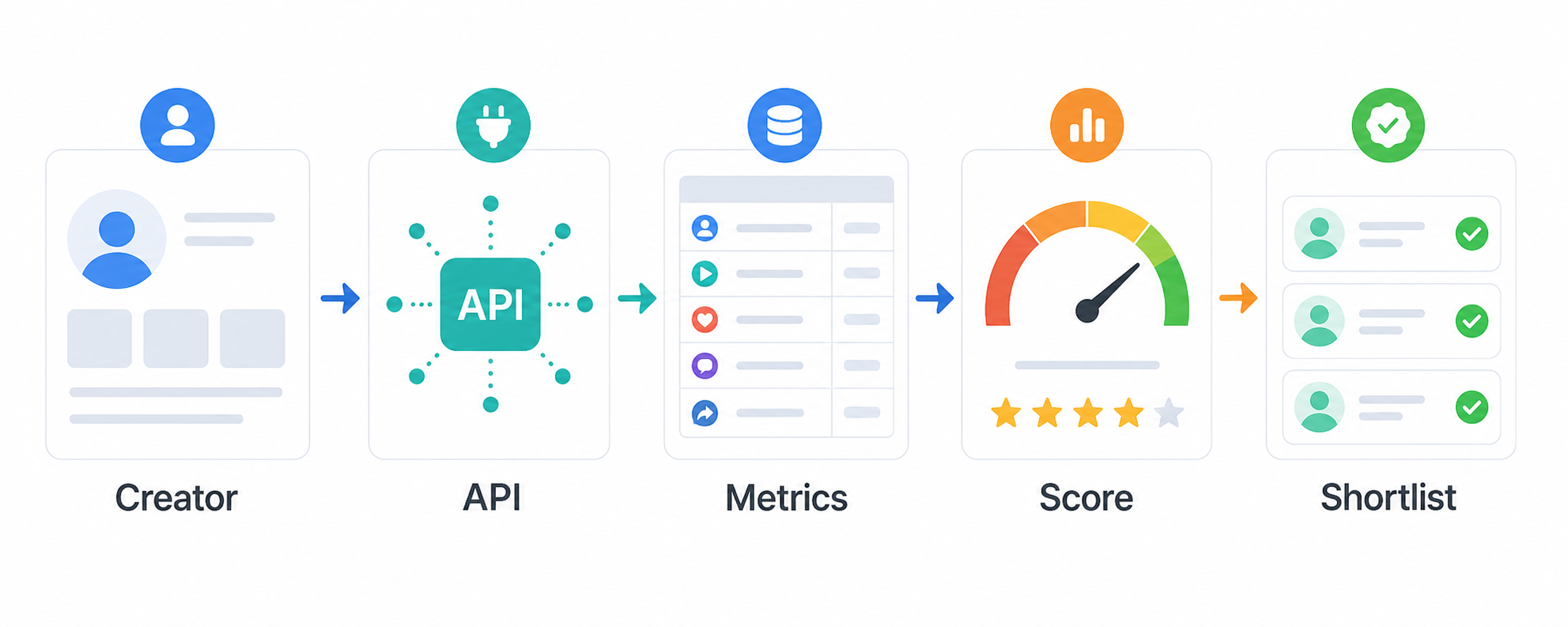
For influencer vetting, that means your team can build a cleaner workflow:
Creator handle or URL
        ↓
KeyAPI
        ↓
Profile and content data
        ↓
Normalized metrics
        ↓
Creator score
        ↓
Shortlist for outreach
Instead of maintaining separate platform integrations, your product can focus on the actual user problem: helping teams choose better creators before they spend campaign budget.
This is especially useful for:
influencer marketing platforms
creator discovery tools
social listening products
e-commerce analytics teams
AI agents
agency dashboards
brand campaign teams
FAQ
What is an influencer analytics API?
An influencer analytics API lets developers collect structured creator data such as followers, posts, views, likes, comments, shares, posting frequency, and recent content performance.
How do you vet influencers with API data?
Start with recent post performance, median views, engagement quality, comment relevance, posting consistency, and brand fit. Do not rely on follower count alone.
What is the best metric for influencer vetting?
There is no single best metric. Recent views, median performance, engagement quality, comment depth, and content relevance should be reviewed together.
Can I compare TikTok, Instagram, and YouTube creators in one dashboard?
Yes, but the data needs to be normalized first. Each platform returns different metrics and structures, so a unified API layer makes comparison easier.
Why use KeyAPI for influencer analytics?
KeyAPI helps developers access structured social media data across multiple platforms through one API layer, reducing the need to maintain separate TikTok, Instagram, and YouTube integrations.