Unified Social Media API vs Official Platform APIs: Which One Fits Your Workflow?

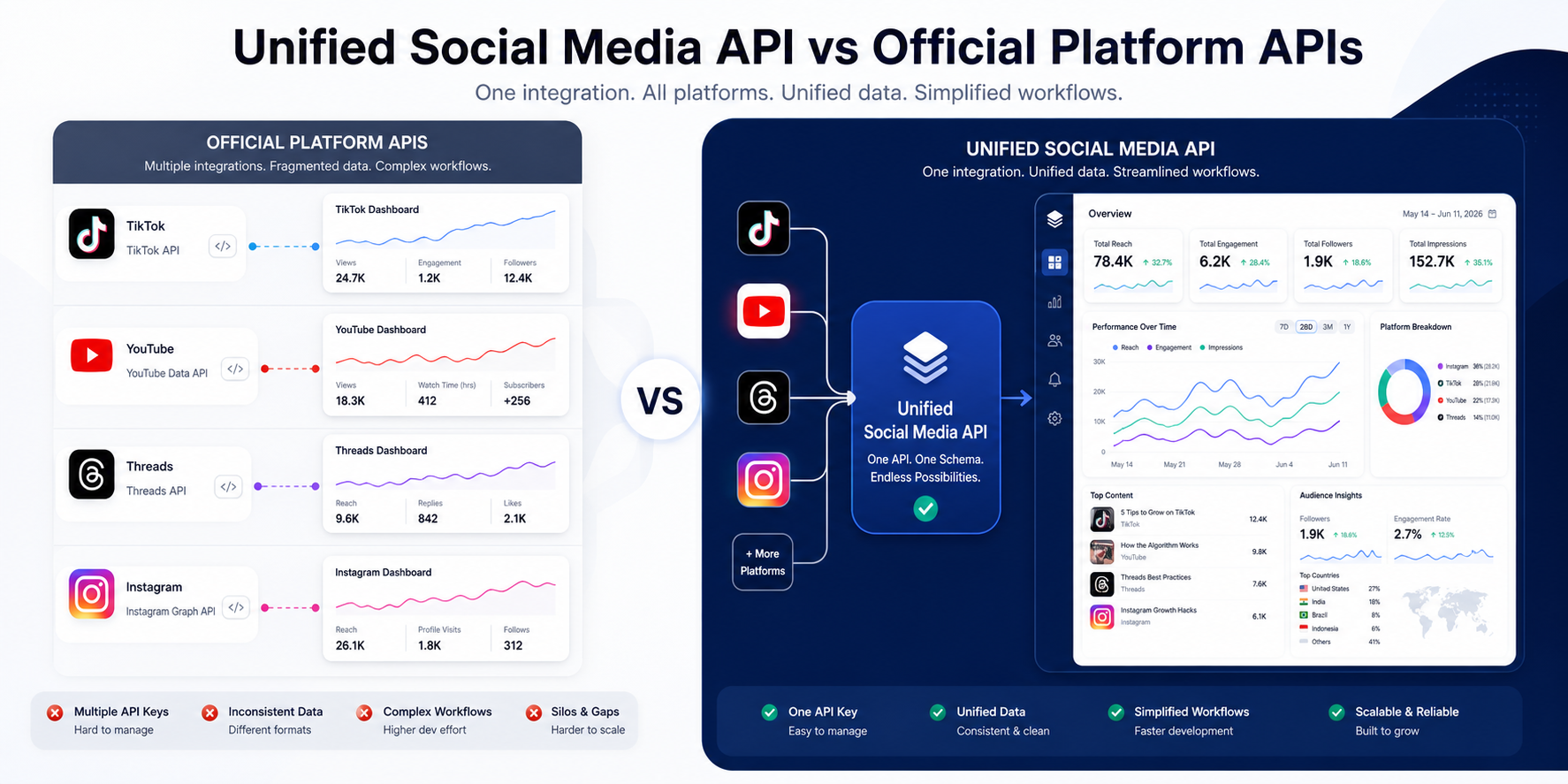
For many teams, the API decision does not start as a strategy question. It starts as a practical one. Someone needs data from TikTok, YouTube, Threads, or Instagram, so the first instinct is usually to connect each platform directly and move on.
That approach often works at the beginning. But once reporting, monitoring, and dashboard work start to spread across several platforms, the problem changes. Teams are no longer asking how to access one endpoint. They are trying to keep several data sources consistent, usable, and worth maintaining. That is why more teams start comparing direct platform integrations with a unified social media API workflow. If the goal is to reduce integration friction and centralize social data access,KeyAPI.aican help simplify that transition.
Why this decision becomes harder as workflows grow
The question is not whether official platform APIs are useful. They are. The real question is whether they still fit the workflow your team has now.
One platform is usually manageable
If your team only works with one platform, an official API may be enough. A direct integration can make sense when:
you only need one platform’s data
your reporting workflow is still simple
one team owns the integration
maintenance costs are still low
platform-specific definitions are acceptable
At that stage, direct access often feels more straightforward.
The problem changes once data becomes multi-platform
The moment your workflow starts to depend on several social channels, the job is no longer just about access. It becomes a problem of consistency.
Different platforms use different metric definitions, different update cycles, and different content structures. That is manageable when someone is checking one dashboard. It becomes harder when several teams need shared reporting, unified monitoring, or one cross-platform view for decision-making.
This is the same shift we covered in our guide to cross-platform reporting with a social media analytics API. Once teams move from one platform to several, the reporting problem usually becomes bigger than the integration problem.
What official platform APIs are good at
Official APIs still have an important role. In many cases, they are the right starting point.
They work well when the use case is narrow
If the workflow is platform-specific, direct access is often fine. That includes cases like:
pulling data for one owned account
building one small internal dashboard
running a narrow automation flow
collecting platform-specific fields that do not need cross-platform comparison
working inside one marketing or content team
In these cases, a direct integration can be enough without adding another abstraction layer.
They are useful when platform detail matters more than standardization
Official APIs are often strongest when a team needs access to one platform’s specific structure, permissions, or objects exactly as they are defined there. That matters when the work depends on platform-native logic rather than shared reporting.
The problem is that most teams do not stay in that phase forever.
Where official platform APIs start creating overhead
The friction usually shows up later, not at the beginning.
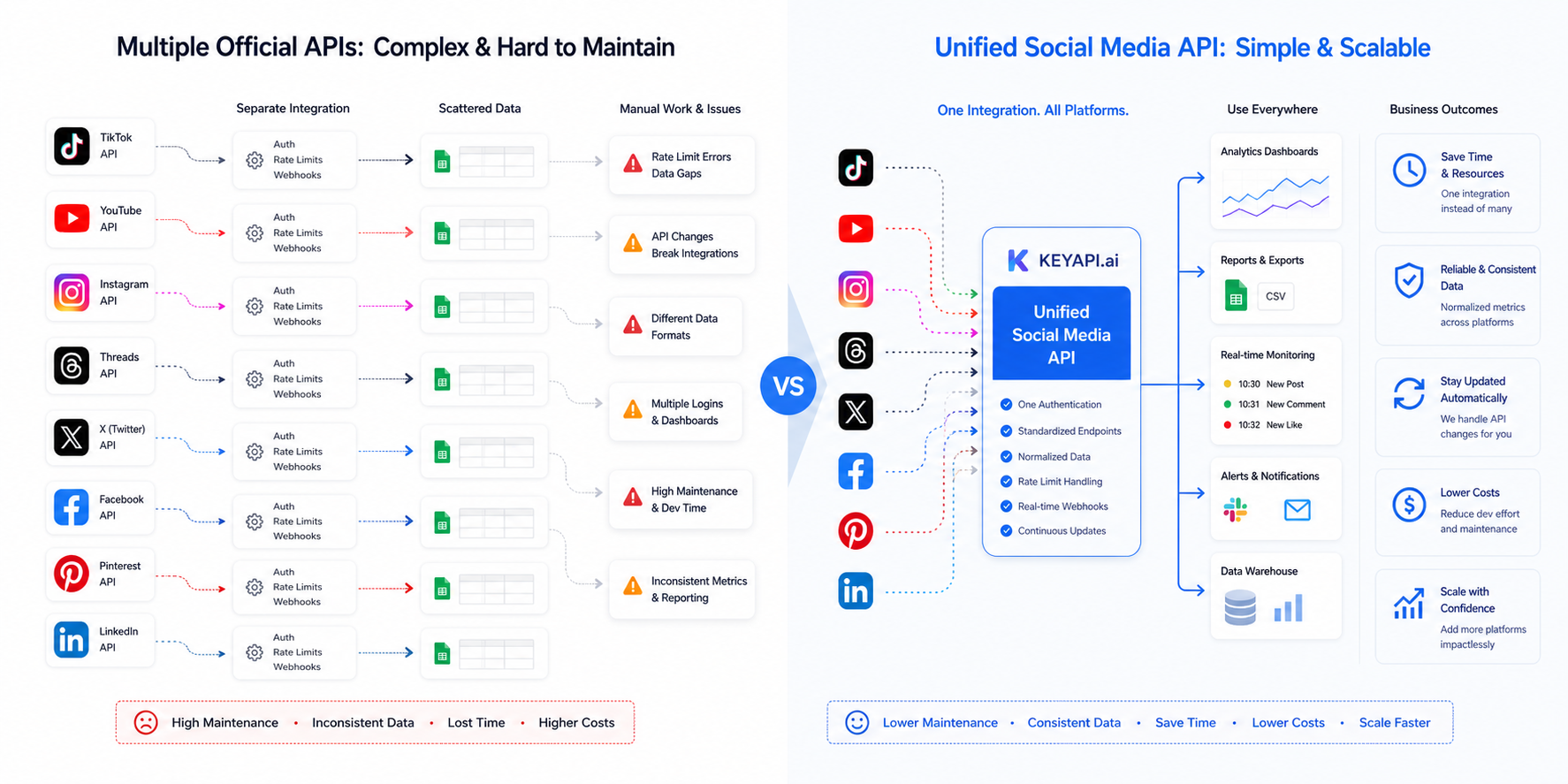
Separate integrations create separate maintenance
Once several platforms are involved, teams often end up managing:
different authentication flows
different rate limits
different schemas
different historical storage logic
different reporting assumptions
At small scale, this feels manageable. Over time, it becomes a patchwork.
Reporting gets harder before it gets better
This is where many teams get stuck. They successfully connect several APIs but still struggle to produce reporting people trust.
The data may be available, yet the workflow still breaks because:
fields do not match cleanly
historical snapshots are inconsistent
each platform refreshes differently
teams define “performance” in different ways
reporting has to be rebuilt every week
That is also why a multi-platform social media dashboardoften fails when it is built on disconnected logic rather than a shared reporting layer.
What a unified social media API layer changes
A unified layer does not make every platform identical. That is not the goal. What it changes is the amount of repeated work needed to build a stable workflow across them.
One collection layer reduces repeated integration work
A unified API becomes more useful when the team wants one process for collecting, storing, and using data across several social platforms.
Instead of maintaining every integration separately, teams can work toward:
one access layer for multiple platforms
more consistent field naming
simpler reporting pipelines
shared logic across teams
less manual reconciliation
That is where a provider such as KeyAPI.aican become more useful than another set of disconnected direct integrations.
It is often a better fit for recurring workflows
A unified API layer is usually more valuable when the team is not just collecting data once. It is running a workflow over time.
That includes:
recurring reporting
cross-platform dashboards
performance reviews
monitoring and alerting
campaign comparisons
multi-team visibility
If the workflow depends on continuity, a shared layer usually creates more value than a set of one-off platform connections.
Which option fits different workflows
This is where the decision becomes easier. The best option depends on the job the API needs to support.
If you only need one platform, official APIs may still be enough
A direct integration often makes sense when:
the business depends on one platform
the team does not need shared reporting
the work is platform-native rather than cross-platform
maintenance is still manageable
In these cases, the extra layer may not be necessary yet.
If you need cross-platform reporting, a unified layer usually fits better
Once a team needs one reporting structure across several platforms, a unified layer starts to make more sense.
That is especially true when the team wants:
one place to review performance trends
one reporting logic across channels
shared access across departments
less time spent stitching exports together
This is exactly the kind of workflow covered in our social media analytics API guide.
If you need ongoing brand visibility, monitoring becomes the bigger need
Some teams think they need reporting first, but what they actually need is better visibility into changes, mentions, and activity spikes.
When the problem is ongoing awareness rather than weekly review, the better question is not just “how do we collect data?” but “how do we notice important changes soon enough to respond?”
That is where a social media monitoring API workflowbecomes more relevant than another static reporting setup.
If you want a usable dashboard, data structure matters more than visuals
A lot of teams blame the dashboard tool when the real issue is upstream.
If the data model is fragmented, the dashboard will be fragmented too. A unified API layer often improves dashboard usability because it reduces inconsistency before the data reaches the dashboard itself.
That is why teams planning a shared reporting view should also think about their dashboard layer strategybefore building another visual report.
Common mistakes teams make when choosing
Choosing between official APIs and a unified layer usually goes wrong in predictable ways.
Mistaking access for workflow readiness
Getting data is not the same as building a working system. Many teams assume that once several APIs are connected, reporting and monitoring will take care of themselves. They do not.
Forcing every metric into one definition
A unified layer should make workflows cleaner, not erase platform differences that still matter. Teams still need judgment about which metrics can be compared and which ones should remain platform-specific.
Waiting too long to centralize
The longer teams wait, the more separate scripts, exports, naming systems, and reporting habits they create. That makes standardization harder later.
Adding abstraction too early
The opposite mistake also happens. Some teams add a unified layer before they have a real cross-platform need. If the work is still narrow and platform-specific, direct integrations may still be the right choice.
How to decide more clearly
If your team is choosing between official APIs and a unified layer, start with workflow questions instead of feature lists.
Ask:
How many platforms does this workflow depend on?
Who needs to use the data?
Is the goal reporting, monitoring, dashboarding, or automation?
How often will this workflow run?
How much repeated maintenance is the team willing to absorb?
Are platform-specific definitions acceptable, or is a shared structure becoming necessary?
Those questions usually reveal the answer faster than a long endpoint comparison table.
Final thoughts
Official platform APIs are not the wrong choice. They are often the right first choice.
The problem is that teams outgrow them quietly. What starts as one direct integration becomes several separate systems, each with its own logic, maintenance burden, and reporting friction. By the time the issue is obvious, the real cost is no longer access. It is inconsistency.
That is the point where a
unified social media API workflow usually becomes more practical. If your team already works across several channels and wants one cleaner path for reporting, monitoring, and shared data access, KeyAPI.ai is worth considering as that next layer.
FAQ
Is a unified social media API always better than official platform APIs?
No. If your team only needs one platform and the workflow is still narrow, a direct official API may be enough. A unified layer becomes more useful when the work depends on several platforms and repeated reporting or monitoring.
When do teams usually outgrow direct platform integrations?
This usually happens when several teams need the same data, reporting starts taking too much manual work, or multiple social channels need to be monitored and compared through one workflow.
Can a unified API replace every platform-specific feature?
Not always. Platform-specific detail still matters in some cases. A unified layer is usually most valuable for shared workflows such as reporting, monitoring, dashboards, and cross-platform data operations.
What is the main advantage of a unified social media API?
The biggest advantage is not just access. It is reducing repeated integration work and making multi-platform workflows easier to maintain over time.