Instagram Username Availability API: Check Handles 2026

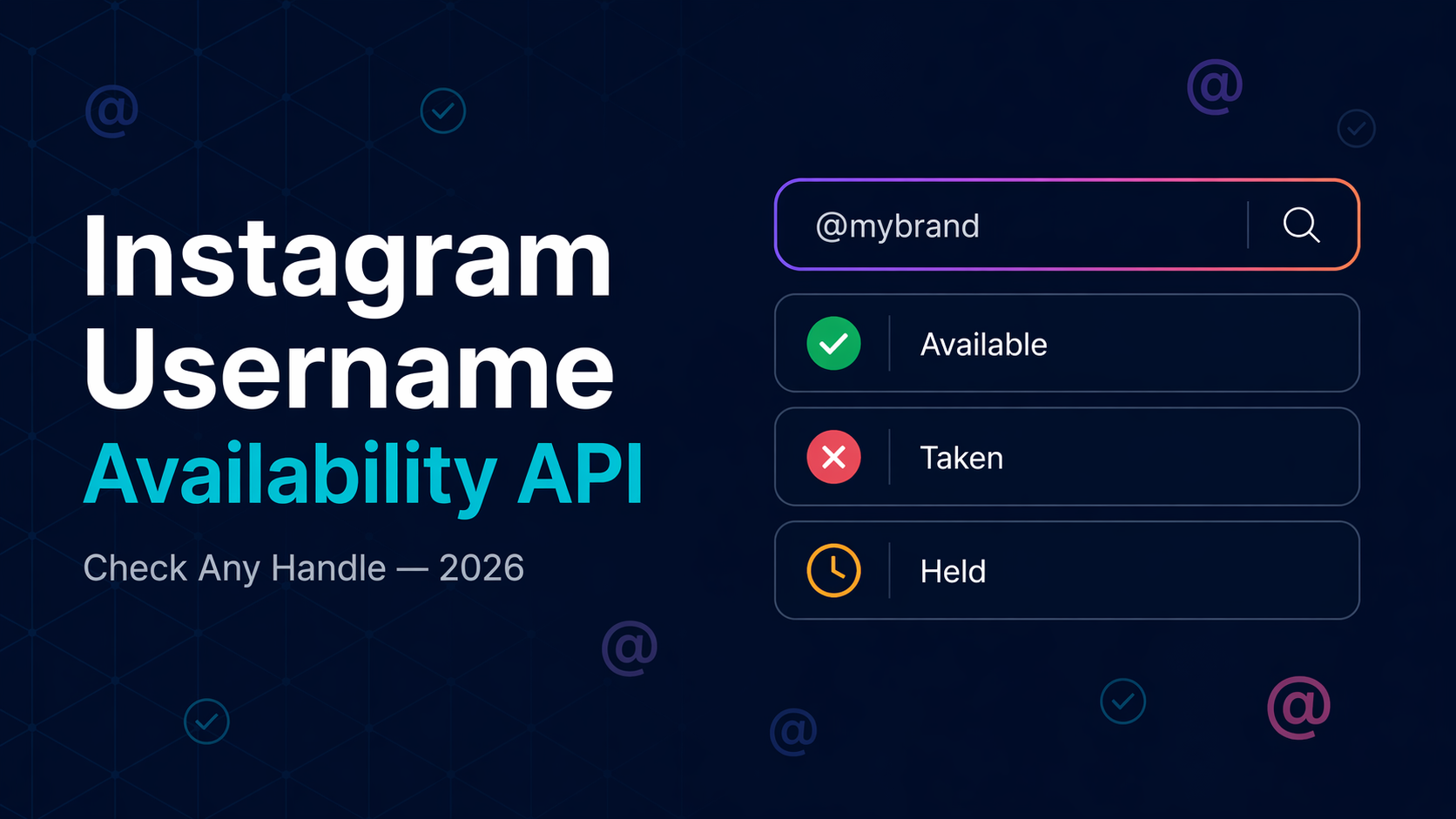
Choosing the right Instagram username is one of the most important branding decisions you'll make. Your handle is your identity — it's how people find you, tag you, mention you, and remember you. And with over 2 billion monthly active users competing for unique names, finding an available username that actually matches your brand is harder than ever.
Whether you're launching a new brand, rebranding an existing business, building a social media management tool, or developing a username registration platform, you need a reliable way to check Instagram username availability programmatically. That's where a username availability API comes in.
This guide covers everything you need to know: Instagram's official username rules, whether the official API supports availability checking, the third-party APIs and tools that do, how to build username checking into your own applications, and best practices for choosing a handle that works.
Instagram Username Rules: What's Allowed
Before checking availability, you need to understand what Instagram actually allows in a username. Submitting usernames that violate these rules will always fail — regardless of whether the name is available.
Character limit: Instagram usernames can be between 1 and 30 characters long. Shorter is almost always better — handles under 15 characters are more memorable, and handles under 10 characters are ideal for maximum brand impact.
Allowed characters: You can only use lowercase letters (a–z), numbers (0–9), periods (.), and underscores (_). Capital letters are accepted during input but automatically converted to lowercase. Instagram treats usernames as case-insensitive — @MyBrand, @mybrand, and @MYBRAND are all the same username.
Restricted characters: No spaces, no hyphens, no @, #, $, %, &, or any other special characters. No emojis. No Unicode characters beyond basic Latin letters and numbers.
Period rules: Periods are allowed but cannot be consecutive (..), and usernames cannot start or end with a period. Periods count toward the 30-character limit.
Uniqueness: Every username must be unique across the entire platform. If someone already has the handle, you cannot use it — even if the account appears inactive.
Prohibited content: Instagram blocks usernames containing domain names or URLs, profanity, hate speech, graphic phrases, or terms that could be used for impersonation.
Deleted account grace period: When an account is deleted, the username may not become available immediately. Instagram holds certain usernames temporarily, especially those associated with violations. This is why you might see "username unavailable" even when no profile appears in search results.
Does the Official Instagram API Support Username Availability Checking?
Here's the direct answer: No, the Instagram Graph API does not have a dedicated endpoint for checking username availability.
The Graph API is designed for managing Business and Creator accounts — publishing content, pulling analytics, managing comments, and accessing insights. It doesn't include any endpoint specifically designed to verify whether a given username is available for registration.
However, there are indirect methods using the official API:
Business Discovery as an Indirect Check
The Business Discovery endpoint lets you look up public profile data for any Instagram Business or Creator account by username. If you query a username and receive profile data back, the username is taken. If the query returns an error indicating the user wasn't found, it might be available — or it might belong to a personal (non-business) account that Business Discovery can't access.
The problem: Business Discovery only works for Business and Creator accounts. It won't detect personal accounts, private accounts, or accounts that exist but aren't categorized as Business/Creator. So a "not found" result doesn't reliably mean the username is available.
The Instagram Web Profile Approach
Some tools query Instagram's web profile API — the same API that Instagram's website uses internally to load profile pages. If a GET request to instagram.com/{username} returns a profile page, the username is taken. If it returns a "page not available" response, the username is likely available.
This approach is more reliable than Business Discovery because it covers all account types — personal, business, creator, public, and private. However, it requires proper session authentication (CSRF tokens, session cookies, and specific headers) and is subject to rate limiting and potential blocking by Instagram's anti-automation systems.
For a comprehensive overview of what the official Instagram API does and doesn't support, see our guide on what the Instagram API is.
Third-Party Instagram Username Availability APIs
Because the official API doesn't provide a dedicated availability endpoint, several third-party services have filled the gap. Here's how they work and what to consider.
How They Work
Most username availability APIs operate by querying Instagram's publicly accessible endpoints — either the web profile API or the mobile API — and interpreting the response. If a profile exists for the queried username, it's taken. If no profile is found, it's available.
The better services handle the technical complexity for you: managing session tokens, rotating proxies to avoid rate limits, handling CSRF authentication, and returning a clean "available" or "taken" response through a simple REST API call.
What to Look For in a Username Availability API
Accuracy. The API should check against all account types (personal, business, creator) — not just business accounts. False positives (reporting a username as available when it's actually taken) are worse than false negatives.
Speed. Username checking should return results in under 1–2 seconds. If you're building a registration flow, users expect near-instant feedback.
Rate limits. If you need to check thousands of usernames (for bulk brand protection or username generation tools), the API's rate limits need to support your volume.
Multi-platform coverage. If you're checking username availability for brand consistency across platforms, an API that covers Instagram alongside TikTok, Twitter/X, YouTube, and other platforms saves you from integrating multiple services.
Reliability. Instagram frequently changes its frontend and API behavior. Choose a provider that actively maintains their integration and doesn't break every time Instagram updates.
KeyAPI for Username and Profile Data
KeyAPI provides Instagram data access through a unified REST API that covers user profiles, posts, Reels, Stories, followers, following, comments, and more. While KeyAPI is designed as a comprehensive social media data platform rather than a single-purpose username checker, its profile lookup endpoints can be used to verify whether a username exists — and if it does, return the full profile data including follower counts, bio, and media.
The advantage of KeyAPI over single-purpose username checkers is breadth. You get Instagram data alongside TikTok (70+ endpoints), YouTube, Twitter/X, LinkedIn, Reddit, and 20+ other platforms through a single API key. If you're building a tool that checks username availability across multiple platforms, KeyAPI covers them all without requiring separate integrations for each network.
KeyAPI operates on a pay-as-you-go credit model with no subscriptions, sub-500ms average latency, and a 99.9% uptime SLA. Start with 100 free API credits at keyapi.ai.
Building a Username Availability Checker: Architecture
If you're building a username availability feature into your own application, here's a practical architecture.
Frontend Layer
The user interface should include a text input field with real-time validation (enforcing Instagram's character rules as the user types), instant feedback showing whether the username meets format requirements, a "Check Availability" button that triggers the API call, clear visual indicators for available (green checkmark), taken (red X), and checking (loading spinner) states, and alternative username suggestions if the desired name is taken.
Validation Layer
Before making any API call, validate the username against Instagram's rules client-side. This eliminates unnecessary API calls for usernames that would fail regardless. Check that the username is 1–30 characters long, contains only letters, numbers, periods, and underscores, doesn't start or end with a period, doesn't contain consecutive periods, and doesn't contain prohibited terms.
API Layer
Send the validated username to your backend, which then queries the username availability API (whether you're using a third-party service or your own implementation). Return a structured response indicating available, taken, or error status.
Suggestion Engine
When a username is taken, generate alternatives that the user might accept. Common patterns include appending numbers (mybrand1, mybrand2), adding underscores (my_brand, my.brand), adding relevant suffixes (mybrand.official, mybrand.shop), and shortening or abbreviating (mybrand → mybrd).
Check each suggestion's availability before presenting it — don't show alternatives that are also taken.
Use Cases for Username Availability APIs
Brand Registration Platforms
When a new business registers their brand name, check username availability across Instagram, TikTok, Twitter/X, YouTube, and other platforms simultaneously. This helps businesses secure consistent handles before launching. A unified API like KeyAPI makes this cross-platform checking possible through a single integration.
Social Media Management Tools
Social media management platforms can integrate username checking into their onboarding flow, helping new users verify their desired handle before they start building content. This prevents the frustrating experience of creating content for an account name that turns out to be taken.
Digital Marketing Agencies
Agencies managing multiple clients can use username availability APIs to check handle availability during the brand strategy phase — before the client commits to a name that doesn't work across platforms.
Domain and Brand Name Generators
Tools that generate brand name suggestions can incorporate Instagram username availability as one of the validation criteria. A brand name that's available as a domain but taken as an Instagram handle is less valuable in 2026 than one that's available everywhere. Research shows 73% of new businesses choose brand names without checking social media availability first.
Influencer Marketing Platforms
When onboarding new creators, verify that the username they provide actually exists and matches their claimed identity. The same API call that checks availability also returns profile data for verification. For more on building influencer tools, see our guide on how brands use the TikTok API to track influencer performance.
Checking Username Availability Across Multiple Platforms
In 2026, brand consistency across platforms is more important than ever. Users expect to find you with the same handle on Instagram, TikTok, Twitter/X, YouTube, LinkedIn, and other platforms.
Checking availability on each platform individually is tedious and requires managing multiple API integrations, each with different authentication, rate limits, and response formats. This is where a unified approach becomes valuable.
KeyAPI supports 20+ platforms through a single API key, making it possible to check whether a username is available (or already in use) across Instagram, TikTok, YouTube, Twitter/X, LinkedIn, Reddit, Pinterest, and more — all from one integration. This dramatically simplifies the architecture of cross-platform username checking tools.
For developers building on TikTok specifically, our guide on what the TikTok API is covers TikTok's username and profile data access.
Tips for Choosing the Perfect Instagram Username
Once you've confirmed availability, make sure your username follows these best practices.
Keep it short. Handles under 10 characters are easiest to remember, type, and share verbally. Every character you add reduces memorability.
Make it pronounceable. If you can't easily tell someone your handle in conversation ("find me at..."), it's too complex. Avoid random number strings, excessive underscores, or unusual abbreviations.
Match your brand name. Ideally, your Instagram handle should match your business name, website domain, and handles on other platforms exactly. Consistency builds brand recognition across channels.
Avoid numbers unless they're part of your brand. Adding random numbers to the end of a taken username (@mybrand247) looks unprofessional and is harder to remember. If your preferred name is taken, consider a meaningful prefix or suffix instead (@shopwithmybrand, @mybrand.official).
Think about search. Instagram's search algorithm prioritizes usernames containing relevant keywords. If you're a bakery, @sarahsbakery is more discoverable than @sarah_s_2024. For more on Instagram discoverability, see our guide on how to get more followers on Instagram.
Test across platforms first. Before committing to a username on Instagram, check that it's available on TikTok, Twitter/X, YouTube, and any other platform you plan to use. Securing the same handle everywhere prevents brand fragmentation.
Claim it immediately. Instagram does not allow username reservations. If a username is available, the only way to secure it is to create an account or change your existing username to claim it. Don't wait — available usernames get taken quickly.
Frequently Asked Questions
Can I reserve an Instagram username without creating an account? No. Instagram doesn't support username reservations. You must create an account or change your existing username to claim an available handle.
What happens when an Instagram account is deleted — does the username become available? Usually yes, but not always immediately. Instagram may hold certain usernames temporarily, especially those associated with policy violations. Some deleted usernames become available within minutes; others may be held for days or weeks.
Are Instagram usernames case-sensitive? No. Instagram treats all usernames as lowercase. @MyBrand and @mybrand are the same username. You can enter it with capital letters for visual appeal, but it won't affect availability or search.
Can I get a taken Instagram username? Generally no. However, if the account using your desired username is inactive, impersonating your registered trademark, or violating Instagram's terms, you can file a report with Instagram. Trademark holders can submit an intellectual property report to potentially reclaim a username.
Why does Instagram say a username is taken when no profile appears in search? The username may belong to a deactivated account (within the grace period), a private account that doesn't appear in search, an account that was recently deleted but the username is still held, or a username that Instagram has blocked due to policy violations.
Final Thoughts
Checking Instagram username availability is a fundamental need for brands, developers, and anyone building tools in the social media space. While Instagram's official Graph API doesn't provide a dedicated availability endpoint, the ecosystem of third-party APIs and tools fills this gap effectively.
For simple, one-off checks, free web-based tools work fine. For developers building username checking into applications — especially tools that need to check availability across multiple platforms simultaneously — a unified API like KeyAPI provides the breadth, reliability, and scalability that production applications require.
The key is acting fast once you find an available username. In a world with 2 billion Instagram users, good handles don't stay available for long.