How Brands Are Using the TikTok API to Track Influencer Performance

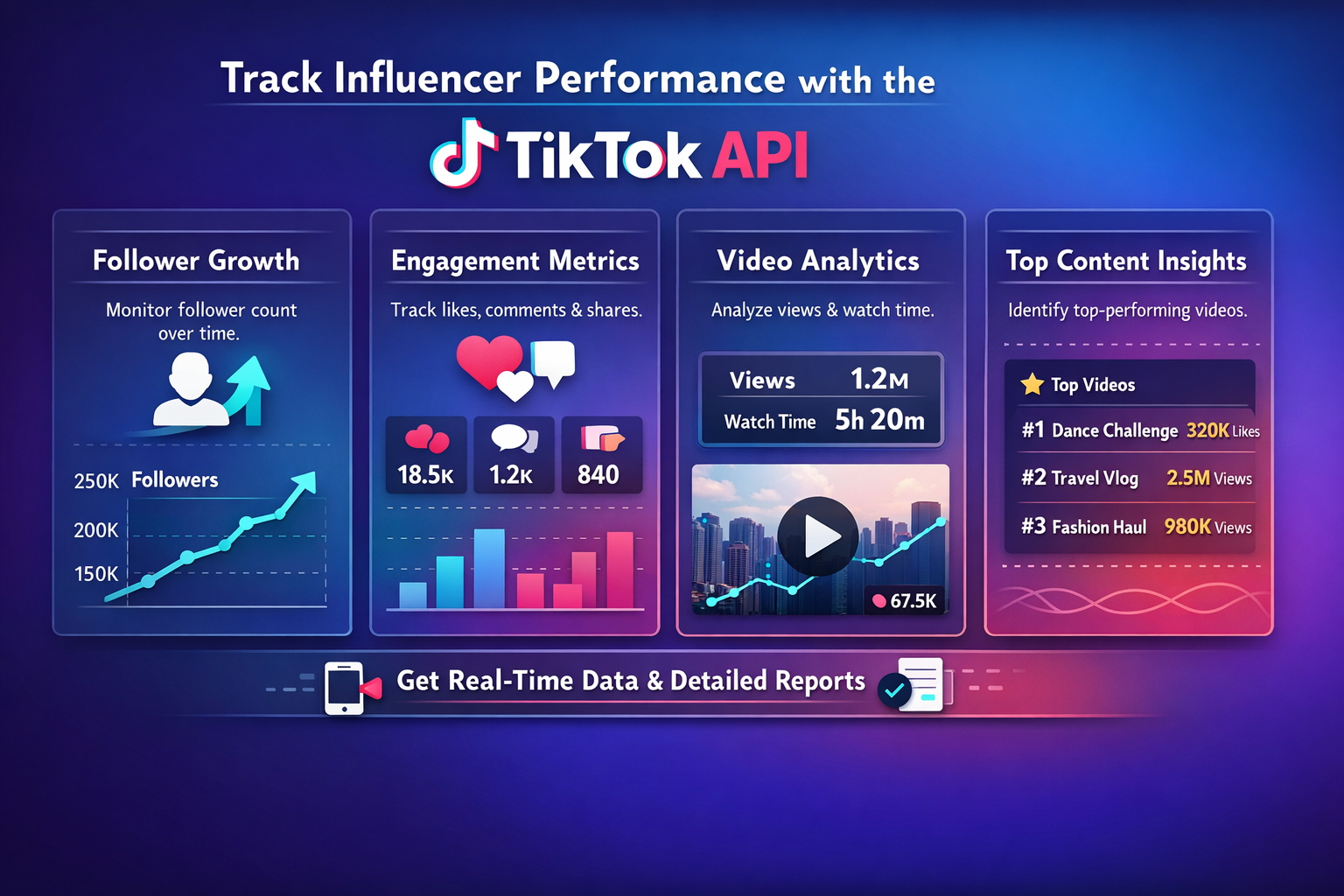
Influencer marketing on TikTok has evolved from a gut-feel experiment into a data-driven growth engine — and the TikTok API is the engine powering that transformation. In 2026, brands can no longer afford to run campaigns on hope alone. With influencer marketing spend projected to near $10 billion globally and TikTok delivering average engagement rates of 5.3% — more than four times that of Instagram — the pressure to measure, optimize, and prove ROI has never been higher.
This guide breaks down exactly how brands are using the TikTok API to track influencer performance in real time, which metrics actually matter, and how to build a scalable measurement system that connects creator content to business outcomes.
What Is the TikTok API and Why Does It Matter for Influencer Tracking?
The TikTok API (Application Programming Interface) is a set of official endpoints provided by TikTok that allows developers, brands, and marketing platforms to programmatically access TikTok data. This includes video performance data, user engagement signals, creator account analytics, and advertising metrics — all in structured, machine-readable formats.
For influencer tracking specifically, the TikTok API enables brands to:
Pull real-time video performance data (views, likes, shares, comments, watch time)
Access creator audience demographics and engagement rates
Monitor campaign content automatically without manual screenshot-and-spreadsheet workflows
Integrate TikTok performance data into broader marketing dashboards and CRMs
Feed attribution models that connect TikTok content to downstream purchases
Without API access, tracking even a modest influencer program across 20–50 creators becomes operationally unmanageable. With it, brands can scale to hundreds of partnerships while maintaining data integrity across every post.
Want to understand the full technical scope of TikTok's developer tools? Our guide on how to use the TikTok API for marketing automation covers the core endpoints, authentication flows, and automation use cases in detail.
The Shift from Vanity Metrics to Performance-First Tracking
For years, influencer marketing was judged by follower counts and "impressions." In 2026, that era is over.
The most sophisticated brands now build influencer programs around three distinct measurement layers:
Layer 1 — Engagement Metrics
These are the surface-level signals the TikTok API delivers most reliably:
Views and reach — total impressions a piece of content generates
Engagement rate — (likes + comments + shares + saves) ÷ views × 100
Video completion rate — the percentage of viewers who watch to the end; widely regarded as the single most important TikTok metric in 2026 because TikTok's algorithm directly rewards high completion
Share rate — a strong indicator of organic amplification potential
TikTok creators under 100K followers average 7.5% engagement rates on the platform — roughly double what similarly-sized Instagram accounts achieve. This is why brands increasingly rely on TikTok API data to surface and prioritize micro-influencers who punch far above their follower count.
Layer 2 — Conversion Signals
Engagement tells you if content resonated. Conversion tells you if it worked commercially. Brands use TikTok API data in conjunction with UTM parameters, affiliate links, and promo codes to track:
Click-through rate (CTR) on links in bio or TikTok Shop
Add-to-cart rate from TikTok Shop-integrated content
Promo code redemption rates attributed to individual creators
Landing page visits generated from specific videos
Layer 3 — Revenue Attribution
The hardest but most valuable layer. Leading brands now measure:
ROAS (Revenue ÷ Campaign Cost) per creator
Customer Acquisition Cost (CAC) broken down by influencer
Customer Lifetime Value (CLV) segmented by which creator first introduced the customer to the brand
Multi-touch attribution — accounting for the fact that a customer may see a TikTok video on Monday and convert through a retargeting ad on Friday
Brands earn an average of $5.78 for every $1 spent on influencer marketing — but capturing that return requires systematic, API-driven tracking, not manual reporting.
How the TikTok API Powers Influencer Performance Tracking: 5 Core Use Cases
1. Automated Content Monitoring at Scale
Manual tracking — checking each creator's posts daily, screenshotting analytics, and entering numbers into spreadsheets — breaks at any meaningful campaign scale. The TikTok API solves this by allowing brands to programmatically pull all content posted by authorized creators, monitor performance at set intervals, and flag over- or under-performing posts automatically.
Brands running 20–50 micro-influencer campaigns simultaneously now have automated systems that detect which videos are gaining traction within the first 2–6 hours of posting — the critical window where amplification decisions (like boosting top-performing content with Spark Ads) matter most.
This kind of automated capture is no longer a nice-to-have. As one industry analysis noted, the sheer volume of creator content across platforms has made automated monitoring an operational necessity.
2. Creator Vetting and Audience Authenticity Checks
Before signing a creator, brands use TikTok API-connected platforms to run authenticity checks that answer: Is this audience real? AI-powered fraud detection tools integrated with the TikTok API can identify fake follower spikes, bot-generated engagement, and abnormal like-to-view ratios — all before any budget is committed.
This pre-campaign diligence is especially important for e-commerce brands where a single fraudulent influencer can skew conversion data and waste significant ad spend. Platforms like HypeAuditor use API-level data to generate audience quality scores that assess follower authenticity, engagement quality, and demographic breakdowns at scale.
3. Real-Time Campaign Dashboards
Rather than waiting for weekly or monthly wrap reports from agencies, brands now build live dashboards that pull TikTok API data continuously. These dashboards typically surface:
Total campaign reach across all influencer posts
Engagement benchmarks vs. brand historical averages
Top-performing creators ranked by engagement rate, completion rate, or conversions
Budget pacing and projected CPM/CPC based on live performance
The practical result: marketing teams can reallocate budget mid-campaign — doubling down on creators whose content is working and pulling spend from those whose content isn't landing.
Building e-commerce campaigns on TikTok? Our guide on the top use cases for the TikTok API in e-commerce covers how brands integrate TikTok API data with Shopify, WooCommerce, and custom attribution systems.
4. Performance-Based Creator Compensation
One of the most significant structural shifts in influencer marketing is the move from flat-fee payments to performance-based compensation models — now adopted by over 53% of brands. The TikTok API makes this possible by providing verifiable, objective performance data that both brands and creators can trust.
Common performance-based structures powered by API tracking:
Tiered bonuses — a base fee plus incremental bonuses when a creator's video surpasses defined view or conversion thresholds
Affiliate commission models — revenue share based on attributable sales tracked through unique promo codes or affiliate links
Renewal triggers — automatic contract renewal or expanded content orders when API data confirms a creator's content converts above benchmark
This shift benefits both parties: brands pay more for proven performers and creators who understand their data can negotiate from a position of strength.
5. Competitive Benchmarking and Category Intelligence
Beyond tracking individual creators, brands with advanced TikTok API integrations use aggregated data to benchmark their influencer program performance against category averages. Questions this answers:
Is our average engagement rate above or below the TikTok benchmark for our niche?
Which content formats (tutorials, reviews, GRWM, unboxing) convert best in our category?
What is the optimal video length for our audience? (Research suggests 45–90 seconds delivers the highest completion rates in most categories)
Which posting times correlate with peak engagement for our target demographic?
Key Metrics Brands Are Tracking via the TikTok API in 2026
Metric | What It Measures | Why It Matters |
Video Completion Rate | % of viewers who watch to end | TikTok's #1 algorithmic ranking signal |
Engagement Rate | (Likes + Comments + Shares) ÷ Views | Content resonance and audience quality |
Share Rate | Shares ÷ Views | Organic amplification potential |
Promo Code Redemptions | Direct conversions attributed to creator | Revenue attribution |
TikTok Shop Click-Through | Viewers who tap product links | Purchase intent signal |
Follower Growth Rate | New followers gained per post | Long-term brand-building impact |
CPV (Cost Per View) | Spend ÷ Total Views | Campaign efficiency |
ROAS | Revenue ÷ Campaign Spend | Overall campaign ROI |
Setting Up a TikTok API Influencer Tracking System: What You Need
Getting accurate influencer performance data through the TikTok API requires a few foundational pieces:
1. TikTok for Developers Access Brands or their technology partners need approved API access via TikTok's developer portal. Access tiers vary — some data requires creator OAuth authorization, meaning the creator must grant your platform permission to read their analytics.
2. Creator Authorization Flow For the richest performance data (including detailed video analytics), creators must authorize your brand's application through TikTok's OAuth system. This is typically built into influencer agreement workflows — creators authorize data access as part of onboarding.
3. A Data Aggregation Layer Raw TikTok API data needs to be stored, normalized, and visualized. Most brands use either a purpose-built influencer marketing platform (which handles API integration) or a custom data pipeline that feeds into a BI tool like Looker, Tableau, or a Notion/Google Sheets dashboard for smaller programs.
4. Attribution Infrastructure API data tells you what happened on TikTok. Attribution tools (UTM parameters, affiliate link networks, TikTok Pixel) tell you what happened after. Both are needed to close the loop between a creator's video and an actual sale.
Need help understanding how to automate these flows? Our detailed walkthrough on TikTok API marketing automation covers the technical setup from authentication to data pipelines.
Common Mistakes Brands Make When Tracking Influencer Performance on TikTok
Relying on last-click attribution only. A customer who sees a TikTok video, searches the brand on Google two days later, and converts through a retargeting ad on Friday — that TikTok video drove the conversion, but last-click attribution gives zero credit to the creator. Multi-touch models are essential.
Optimizing for follower count instead of engagement. TikTok's algorithm distributes content based on engagement quality, not creator follower size. A 15K-follower creator with a 12% engagement rate is almost always a better investment than a 500K-follower creator with 1.2%.
Ignoring video completion rate. Views without completion context are misleading. A video with 100K views and a 20% completion rate reached fewer meaningful impressions than one with 30K views and 80% completion.
Tracking content but not the creator relationship. Individual post performance fluctuates. The best brands use API data to track creator performance trends over time — identifying which creators show consistent performance across multiple campaigns, not just one viral moment.
Skipping fraud checks. Inflated follower counts and engagement pods can make a creator look far more valuable than they are. API-level authenticity checks before partnership significantly reduce budget waste.
The TikTok API Entity: What It Is and Why It Matters for Marketers
The TikTok API as an entity in the marketing technology landscape represents TikTok's official programmatic data layer — the structured, authenticated mechanism through which third-party platforms, brands, and developers access TikTok's data ecosystem. It is distinct from TikTok's consumer app and advertising interfaces, and operates under TikTok's Terms of Service and developer policies.
For brands, understanding the TikTok API as an entity means understanding that:
All data accessed through official API channels is consented and compliant — either publicly available or explicitly authorized by creators via OAuth
API data is more reliable than third-party scraping because it comes directly from TikTok's own data infrastructure
Access is tiered — the depth of data available depends on the type of API access granted and the permissions creators authorize
The TikTok API operates across several product surfaces: the Content Posting API, Research API, Login Kit, TikTok for Business API, and the TikTok Shop API — each serving different tracking and automation needs
For marketers specifically, the TikTok for Business API and TikTok Shop API are the most relevant endpoints for influencer performance tracking and e-commerce attribution.
Explore more about how the TikTok API supports commerce workflows in our guide to TikTok API use cases for e-commerce brands.
What's Coming Next: AI-Powered Influencer Intelligence
The next frontier in TikTok API-powered influencer tracking is predictive analytics. Platforms are beginning to use machine learning models trained on historical TikTok API data to:
Predict video performance before a post goes live, based on creator historical completion rates, content category, and posting time
Score audience quality dynamically as a creator's follower base evolves
Identify content formats most likely to convert for a specific product category
Surface rising micro-creators before their engagement metrics peak — enabling brands to lock in partnerships at lower rates
As TikTok's creator economy matures, the brands winning on the platform in 2026 and beyond will be those treating influencer marketing as a data system, not a creative experiment. The TikTok API is the infrastructure that makes that possible.
Frequently Asked Questions
What data can brands access through the TikTok API for influencer tracking? With appropriate developer access and creator authorization, brands can access video view counts, engagement data (likes, comments, shares), video completion rates, audience demographics, follower growth data, and TikTok Shop conversion metrics.
Do influencers need to authorize data sharing for brands to track performance? For detailed analytics data, yes — creators must authorize a brand's application through TikTok's OAuth system. Public metrics (views, likes, comments on public posts) are accessible without creator authorization, but richer analytics require consent.
Can the TikTok API integrate with CRM or e-commerce platforms? Yes. Brands build integrations between TikTok API data and platforms like Shopify, Salesforce, HubSpot, and custom BI tools to connect creator content performance with sales data and customer records.
What is a good engagement rate benchmark for TikTok influencers? TikTok delivers an average engagement rate of around 5.3% across the platform. Micro-influencers (under 100K followers) often achieve 7–10%+. Rates below 2–3% for smaller creators warrant closer scrutiny of audience authenticity.
How does the TikTok API differ from third-party scraping tools? Official API access is compliant with TikTok's Terms of Service, uses authenticated data directly from TikTok's infrastructure, and is eligible for richer data through creator authorization. Scraping tools often violate TikTok's ToS, carry legal risk, and deliver less reliable data.
Summary
The TikTok API has become the operational backbone of serious influencer marketing programs in 2026. Brands using it well aren't just tracking vanity metrics — they're building closed-loop systems that connect creator content to real business outcomes: sales, customer acquisition, and long-term brand growth.
The brands that will dominate TikTok influencer marketing going forward are the ones who treat their creator programs as data systems: structured, measured, and continuously optimized through API-powered intelligence.
Explore more on KeyAPI.ai: