Instagram Business Discovery API: What Can You Actually Get?

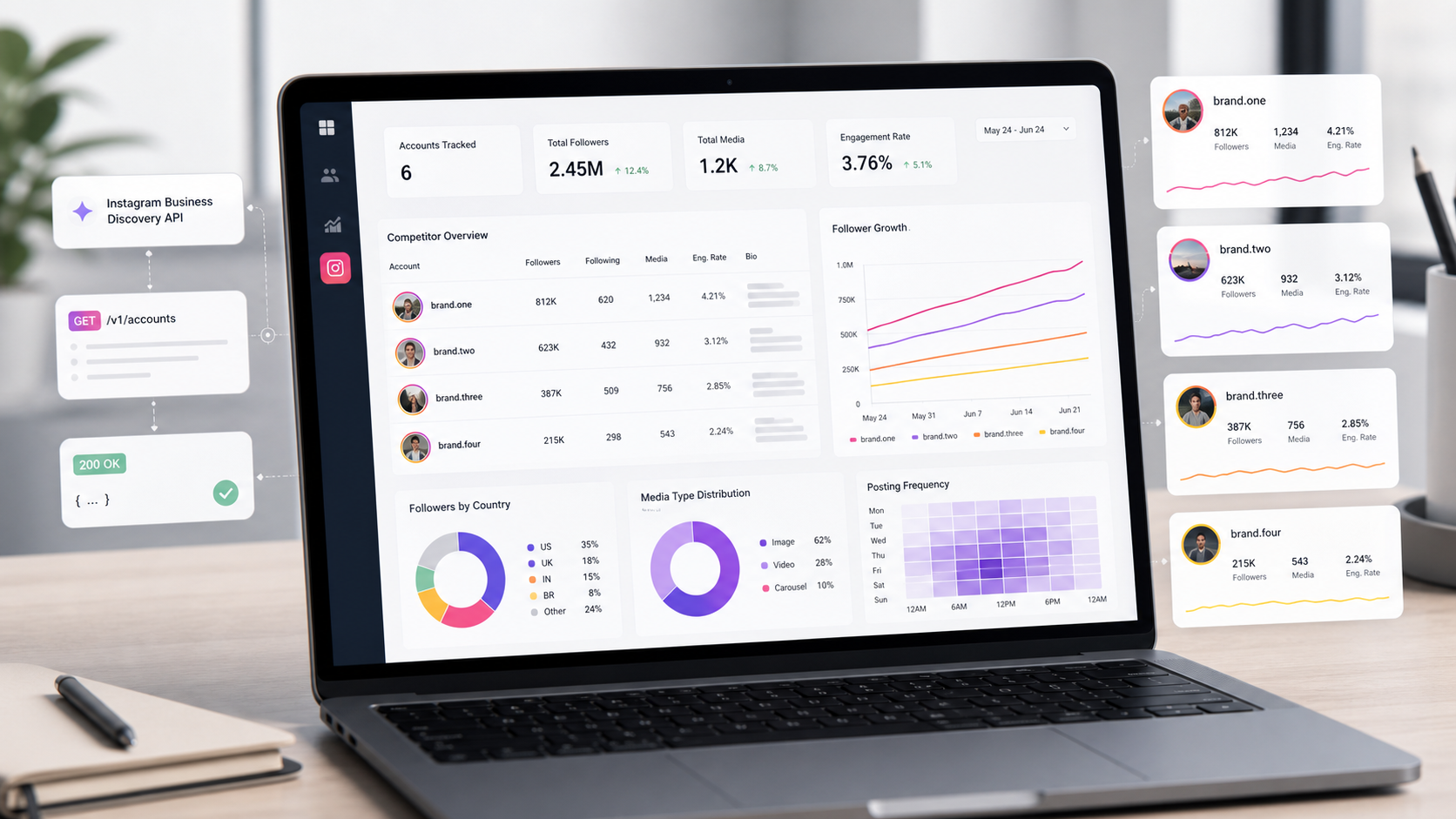
Most people searching for the Instagram Business Discovery API are not looking for a definition. They are trying to answer a practical question:
Can the official Instagram API give me useful data from another account without scraping?
In most cases, that means one of three things:
- checking a competitor's follower count
- pulling public profile data into a dashboard
- deciding whether the official API is enough for a real monitoring workflow
That is where the confusion starts. Instagram shows follower numbers, bios, websites, and recent content in the app, so it is easy to assume the API exposes all of that in a straightforward way. It does not. The Business Discovery API is useful, but only for a specific layer of data.
If you are still trying to get a follower list or following list, read [Instagram Graph API: Get Followers List & Following] first. That article explains the hard limitation. This page is about the next question: if follower lists are not available, what can the official route still do for competitor tracking?
What the Instagram Business Discovery API actually gives you
The simplest way to understand Business Discovery is this:
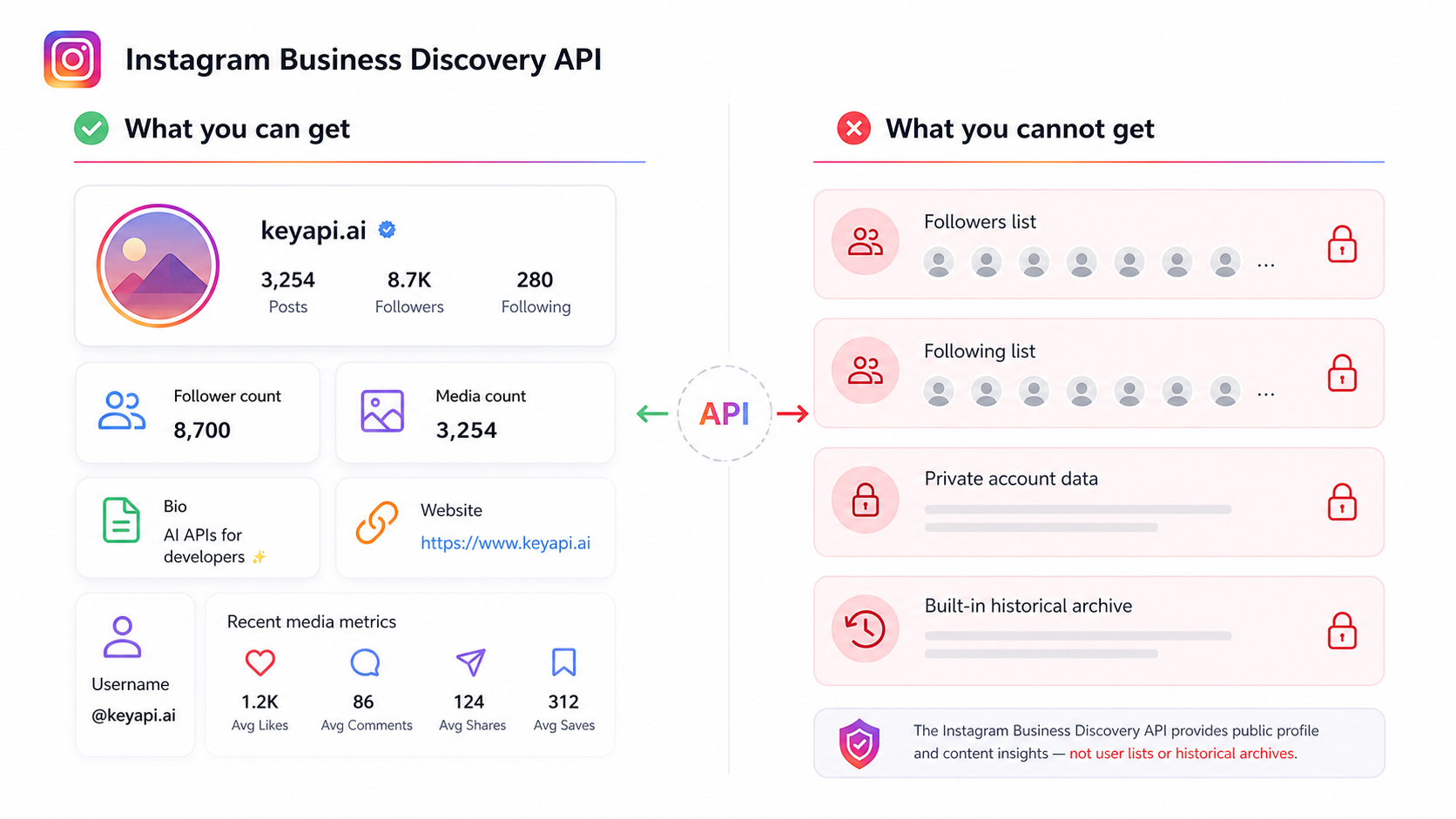
It is an official way to retrieve **public professional account data** from another Instagram Business or Creator account.
That sounds narrow, but for many teams it is already useful enough.
Data you can usually retrieve
In a normal Business Discovery workflow, teams use the endpoint to collect:
- follower count
- follows count
- media count
- username
- biography
- website
- profile picture
- recent media fields used for benchmarking
For a growth team, agency, or analytics product, that is often enough to build a lightweight competitor snapshot.
Data you should not expect
This is the part that trips people up.
Business Discovery does not give you:
- a follower list
- a following list
- private account data
- a built-in follower growth history
- unrestricted access to every public Instagram account in any format you want
That distinction matters. A follower count is a public metric. A follower list is identity-level audience data. The official API does not treat those as the same thing.
If your main use case is still follower count in a broader sense, [Instagram API Follower Count] is the better companion article because it covers the wider follower-data picture.
Why this endpoint matters for competitor tracking
A lot of API content gets stuck at the documentation layer. Real teams do not think in endpoint names. They think in reporting tasks.
A brand team may want to compare three competitors before a product launch.
An agency may need a monthly benchmark report for a client.
A SaaS team may want profile-level Instagram data before building a larger creator or competitor dashboard.
None of those teams necessarily need a raw follower list. What they need is a usable public account snapshot.
A good use case looks like this
Suppose you track five competing skincare brands on Instagram.
You do not need to know every individual follower. What you actually need is:
- current follower count
- how many accounts they follow
- how much content they publish
- whether the bio or website changed
- enough public content context to compare direction over time
That is where Business Discovery fits. It is not a full audience-intelligence API. It is a public professional account intelligence layer.
Where it becomes commercially useful
Once you stop asking for everything and focus on the right reporting layer, the endpoint becomes much more useful.
It works well for:
- competitor benchmarking
- creator shortlisting
- agency reporting
- category monitoring
- public account enrichment
That is why this article should sit next to [What Is the Instagram API?], not replace it. The overview page explains the ecosystem. This page helps someone decide whether this specific route is enough for the workflow in front of them.
Where teams misread the official API
Most wasted time around Instagram APIs comes from one wrong assumption:
If it is visible in the app, the official API should expose it cleanly.
That is not how Instagram's official model works.
Mistake 1: confusing follower count with follower access
This is the most common mistake.
A public follower count is one thing.
A list of actual followers is another.
Teams often arrive here because they first searched for follower-list access, found out the answer was no, then started looking for the closest official alternative. That is exactly the search path that makes Business Discovery attractive.
Mistake 2: expecting history without storing snapshots
Another common mistake is expecting the API to give you a built-in growth chart.
It will not.
If you want to track follower growth over 30, 60, or 90 days, you need to store repeated profile snapshots yourself. The official endpoint gives you the current state. Historical reporting is something you build on top of it.
Mistake 3: relying on outdated Instagram API assumptions
A lot of older Instagram API tutorials still mix together old and new models. That creates confusion fast.
If your team is still working from older consumer-style assumptions, review [Instagram Basic Display API: Complete Guide] before building anything important. It helps reset expectations around what the official ecosystem looks like now.
What data is actually worth saving
If you are already pulling competitor follower count, do not stop there.
Follower count alone is too thin. It tells you account size, but not enough about direction, positioning, or content behavior.
A better competitor snapshot
A stronger profile snapshot usually includes:
- follower count
- follows count
- media count
- username
- bio
- website
- profile image URL
- capture date
- recent post metadata if your workflow needs it
This gives you a better reporting base and a more useful historical record.
Why context matters more than a single metric
Follower growth can mean very different things.
An account may gain followers because:
- it posted more often
- it leaned harder into Reels
- it changed content format
- it launched a campaign
- it was mentioned somewhere else
If you only store the follower number, you see the outcome without enough context to explain it.
That is why good competitor tracking starts with follower count, but does not end there.
If your workflow also involves checking public account names or availability, [Instagram Username Availability API] is another useful supporting page in this cluster.
When the official route is enough
The official Business Discovery route is usually good enough when:
- you track a limited number of competitor or creator accounts
- you mainly need public profile-level data
- your reporting cadence is weekly or monthly
- Instagram is one piece of a relatively simple workflow
- your team can live with Meta's setup and approval model
For these cases, the official route is a reasonable place to start.
Teams that usually do fine with it
Business Discovery is often enough for:
- in-house brand teams doing monthly competitor reviews
- agencies building lightweight Instagram reports
- early-stage products testing public account monitoring
- teams that need profile-level data, not audience-level identity data
That is an important distinction. If your workflow stays narrow and clear, the official route may be perfectly acceptable.
When the official route stops being enough
This is the judgment point most articles skip, but it is the part users actually need.
Business Discovery starts to feel small when:
- you need broader account coverage
- you need faster setup
- you need more than a narrow profile-level dataset
- you want Instagram data alongside TikTok, YouTube, Reddit, and Threads
- you are building a larger internal or commercial analytics product
At that point, the question changes.
It is no longer:
"Can I get this one field from the official API?"
It becomes:
"Is the official route still the right foundation for the workflow I am trying to build?"
The practical decision most teams eventually face
For a small monitoring workflow, the official route is often enough.
For a broader product or multi-platform intelligence workflow, it usually is not.
That is where [KeyAPI's Instagram API] becomes easier to justify. Instead of stitching together one narrow route at a time, teams can evaluate a broader Instagram data layer that fits more naturally into larger reporting systems. If the use case already spans multiple social platforms, [KeyAPI.ai] is the broader product context behind that decision.
This is not a question of "official good, unofficial bad" or the reverse. It is a workflow question:
What is the smallest data system that can support the job you actually need to do?
How this article fits into your Instagram content matrix
It works best as one node in a clear Instagram API cluster.
A reader landing here may also need:
- [Instagram Graph API: Get Followers List & Following]are still trying to solve follower-list access
- [Instagram API Follower Count] need the bigger follower-data picture
- [What Is the Instagram API?]are still early in the research stage
- [Instagram Basic Display API: Complete Guide]are working from outdated setup assumptions
- [Instagram Username Availability API]workflow overlaps with profile lookup
This is not just good internal linking. It is good task design. Each page should solve a different question, not repeat the same topic with slightly different wording.
Final answer: is Business Discovery enough?
If your goal is public competitor tracking, follower count checks, and profile-level Instagram data, the Business Discovery API can be enough.
If your goal is follower-list access, private audience visibility, or a broader social intelligence system, it will stop being enough very quickly.
That is the right way to judge it.
Do not ask whether the endpoint sounds powerful. Ask whether it covers the reporting job, product task, or monitoring workflow you actually need to support.
For some teams, the official route is a clean starting point.
For others, Business Discovery is the moment they realize they need a broader data layer than one official endpoint can reasonably provide.