YouTube Content Gap API: How to Find Topic Opportunities from Search Data

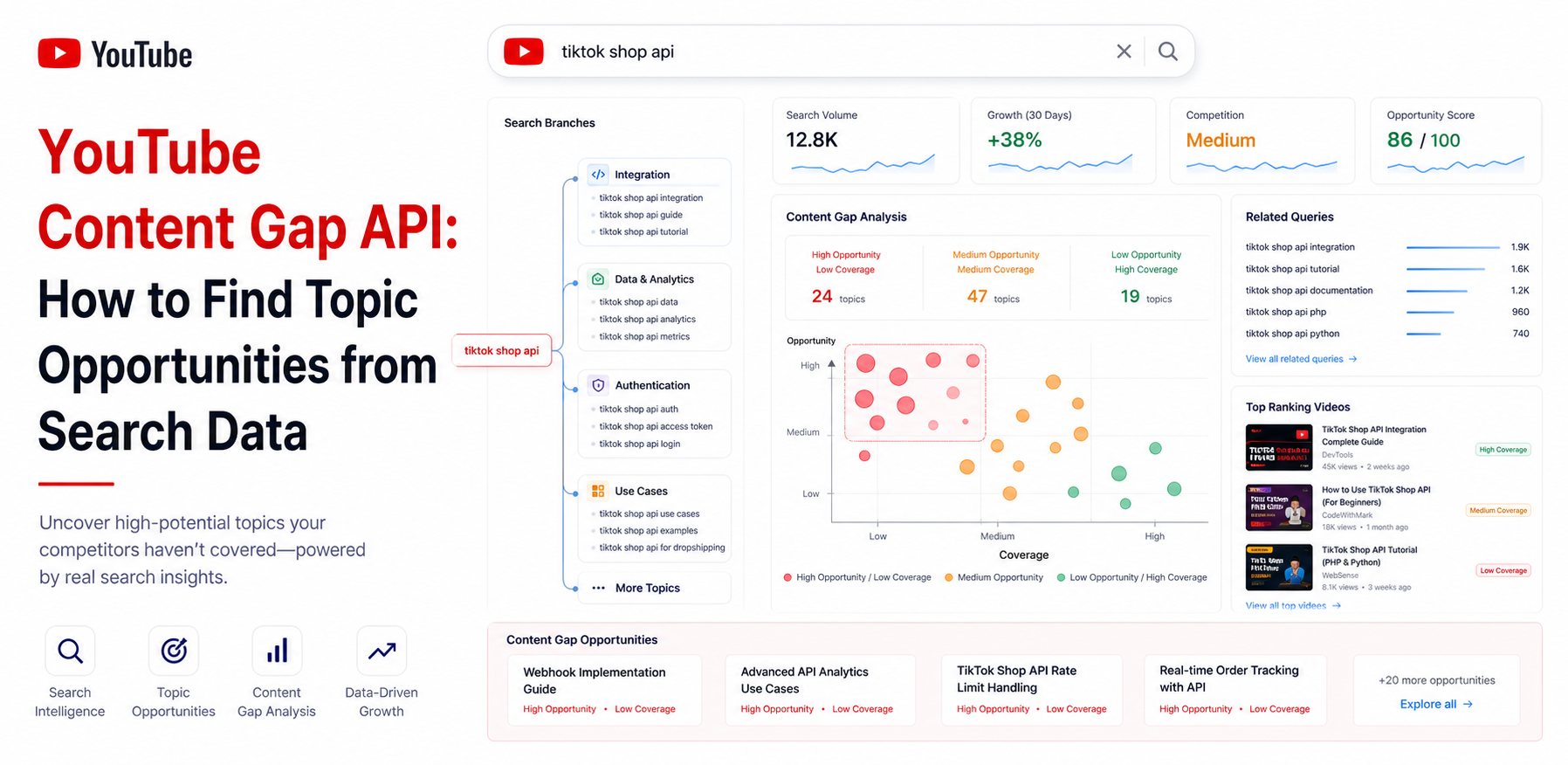
Most teams do not run out of video ideas because YouTube is too small. They run out of ideas because they keep looking at the same obvious topics everyone else is already covering. A keyword may have demand, but that does not automatically mean there is still room to win.
That is where content gap analysis becomes useful. Instead of only asking what people search for, teams start asking which related topics are under-served, which query branches are still weakly covered, and where search demand is clearer than the existing content supply. If you want the broader search-data foundation behind this workflow, our guide to the YouTube Related Searches API is the best starting point. And if your team needs a cleaner way to work with YouTube search intelligence at scale, KeyAPI.ai can help simplify that process.
Why content gap analysis matters on YouTube
A lot of YouTube content planning fails for the same reason: teams confuse popular topics with good opportunities.
A topic can be large, visible, and highly searched, but still be a poor target if the results are saturated, repetitive, or dominated by strong channels. On the other hand, a smaller branch of that topic may still have real search intent and much weaker content coverage.
That is why content gap work matters. It helps teams move from:
obvious topics
broad keywords
repeated ideas
imitation-based planning
toward:
under-covered queries
narrower topic branches
clearer search intent
more usable content opportunities
What a YouTube content gap API should actually help you find
This kind of workflow is not about generating random content ideas. It is about identifying where demand and supply are out of balance.
Search branches with weak coverage
One of the clearest opportunities on YouTube comes from query expansion. A broad topic may look crowded, but once it expands into more specific search suggestions, some branches often show weaker coverage than others.
That makes search-data expansion useful for finding:
narrower how-to topics
practical troubleshooting queries
intent-specific subtopics
creator workflow questions
lower-competition content angles
Topics competitors touch but do not cover well
A content gap is not always a totally missing keyword. Sometimes competitors already touch the topic, but the quality, depth, or clarity of coverage is still weak.
That matters because teams do not always need an untouched topic. Sometimes they need a better angle, clearer structure, or more complete answer.
Opportunities hidden inside related search behavior
This is where search data becomes more useful than isolated brainstorming. If you are only collecting one keyword list, you miss how users naturally branch into adjacent needs.
That is why many teams use YouTube search suggestions as an early signal for content opportunity mapping. If your current focus is still earlier in the workflow, our guide to the YouTube Autocomplete API for keyword research is a strong companion piece to this article.
Why search data works better than guesswork
Many editorial teams think they are doing content planning when they are really doing intuition planning.
That usually leads to two problems:
repeating the same topic formats everyone else is already using
missing smaller search opportunities that look less obvious at first
Search data reveals how topics expand
When users search on YouTube, they rarely stop at one flat keyword. They move into longer, more specific phrases, and those phrases often expose the real problem they are trying to solve.
That is valuable because topic opportunities often appear at the point where search intent becomes more concrete.
Gap analysis is more useful than raw keyword collection
A large keyword list is not enough on its own. The real value comes from comparing:
what users appear to want
what related queries suggest
what current search results already cover
where weak or repetitive coverage still exists
That turns search data into a strategy tool instead of a spreadsheet archive.
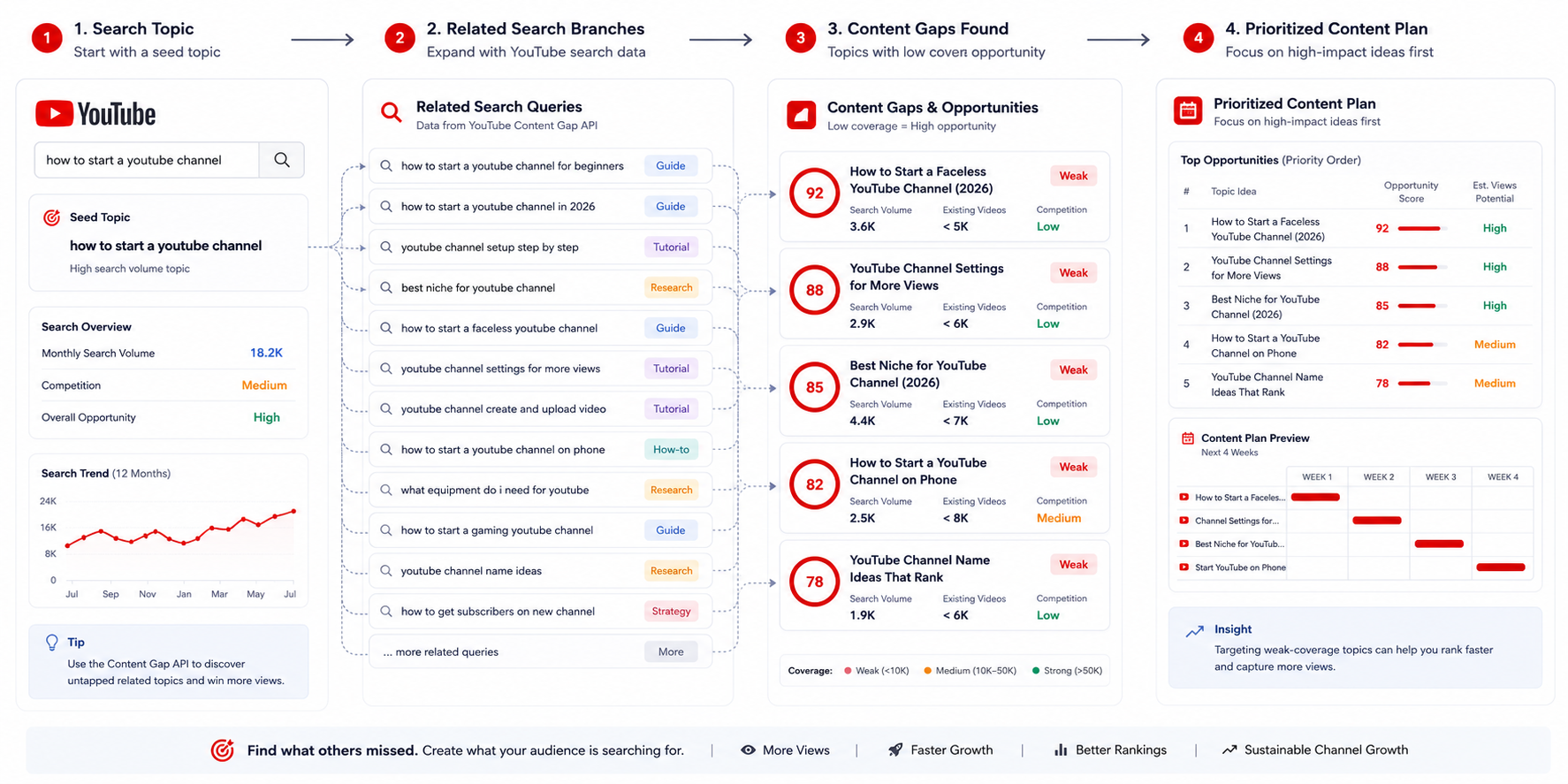
How teams use a YouTube content gap workflow in practice
A practical content gap workflow usually starts with a seed topic, not a finished editorial calendar.
Start with one broad topic area
Choose a topic your brand, channel, or product actually cares about. Then use related search and autocomplete data to expand it into more realistic search branches.
At this stage, the goal is not to publish immediately. The goal is to see the shape of the topic.
Expand into second-layer search branches
The first layer of keyword expansion is usually too broad. The more useful opportunities often appear in second-layer suggestions.
For example, a broad theme can branch into:
beginner questions
comparison topics
workflow problems
setup tutorials
troubleshooting issues
tool-specific variations
This is where content gap analysis starts becoming more useful than generic keyword research.
Compare demand signals with actual result coverage
Once you have search branches, the next step is not just to save them. It is to check what the current YouTube results already look like.
Look for patterns such as:
weak titles
repetitive angles
shallow tutorials
outdated information
results that answer only part of the query
videos that rank but do not fully satisfy intent
That is where a topic starts to move from “keyword idea” to “actual opportunity.”
What this article should not be confused with
This page is not the same as a general keyword research guide.
H3: It is not only about autocomplete
Autocomplete is useful, but this article is about what comes after keyword expansion. If your goal is still to collect and organize YouTube search suggestions, start with the YouTube Autocomplete API guide.
H3: It is not a competitor scraper guide
Competitor review can help with content gap analysis, but the point here is not to copy another channel’s content list. The point is to identify where search demand exists but current coverage is weak, incomplete, or too repetitive.
H3: It is not a generic “content ideas” article
This workflow only works if the ideas come from actual search behavior. Otherwise, the page becomes another list of brainstormed suggestions with no clear evidence behind them.
What makes a good YouTube content opportunity
Not every gap is worth pursuing.
H3: Good opportunities have clear intent
The best opportunities usually come from queries where the user need is easy to understand.
That includes:
specific how-to needs
setup questions
feature comparisons
recurring troubleshooting
task-based search behavior
H3: Good opportunities are easier to position
A topic gap becomes more valuable when you can clearly define what your video would do better than the current results.
That might mean:
more up-to-date information
clearer structure
a better beginner explanation
stronger examples
a more focused answer to the exact query
H3: Good opportunities fit your real expertise
Search demand matters, but alignment matters too. A topic may look open, but it is still a weak content choice if your team cannot answer it with authority.
That is one reason strong content gap work is not just about finding missing queries. It is about matching those queries to what your team can explain well.
How to avoid turning content gap research into another messy process
A lot of teams do the research and then lose the value in bad organization.
H3: Keep every query tied to its source topic
If a query came from a seed term, a related search expansion, or a suggestion branch, keep that relationship. It helps you understand why the opportunity exists.
H3: Group by intent, not just wording
A cleaner structure is often more useful than a longer list. Group keywords by what the user wants:
learn something
fix something
compare options
choose a tool
complete a task
That makes the final output more useful for editorial planning.
H3: Re-check important gaps over time
A gap today may disappear later. A crowded topic today may also open up in a few months as search behavior shifts.
That is why recurring search observation is more useful than one-time export work. Teams that revisit search patterns regularly usually make better topic decisions than teams that collect one list and never return to it.
When this article is the right next step
This page is the right fit if your main question is:
how to find under-covered YouTube topics
how to identify missed opportunities from search data
how to move from keyword research into content planning
how to use related search behavior to find better video ideas
If your question is still more foundational, start with:
Those two pages set up the search-data workflow this article builds on.
Final thoughts
A good YouTube content gap workflow does not begin by asking what topics are popular. It begins by asking where search demand is clearer than the current content available to satisfy it.
That is the difference between generic keyword research and more useful opportunity mapping. If your team is trying to turn YouTube search behavior into more structured content planning, KeyAPI.ai can help make that workflow easier to repeat, organize, and scale.
FAQ
What is a YouTube content gap API?
A YouTube content gap API helps teams use search-related data to identify topics, query branches, or opportunities that appear under-served compared with current search demand.
Is content gap analysis different from keyword research?
Yes. Keyword research helps you collect and expand terms. Content gap analysis goes further by comparing search opportunity with the current quality and completeness of available content.
Do I need autocomplete data for content gap analysis?
Usually yes. Autocomplete and related search data are both useful because they help you see how broad topics expand into more specific search intent.
Can small channels use this workflow too?
Yes. In many cases, smaller channels benefit even more because content gap analysis helps them avoid broad, saturated topics and focus on clearer opportunities.